Problem
Leaks from rooftop and podium pools into the apartments below
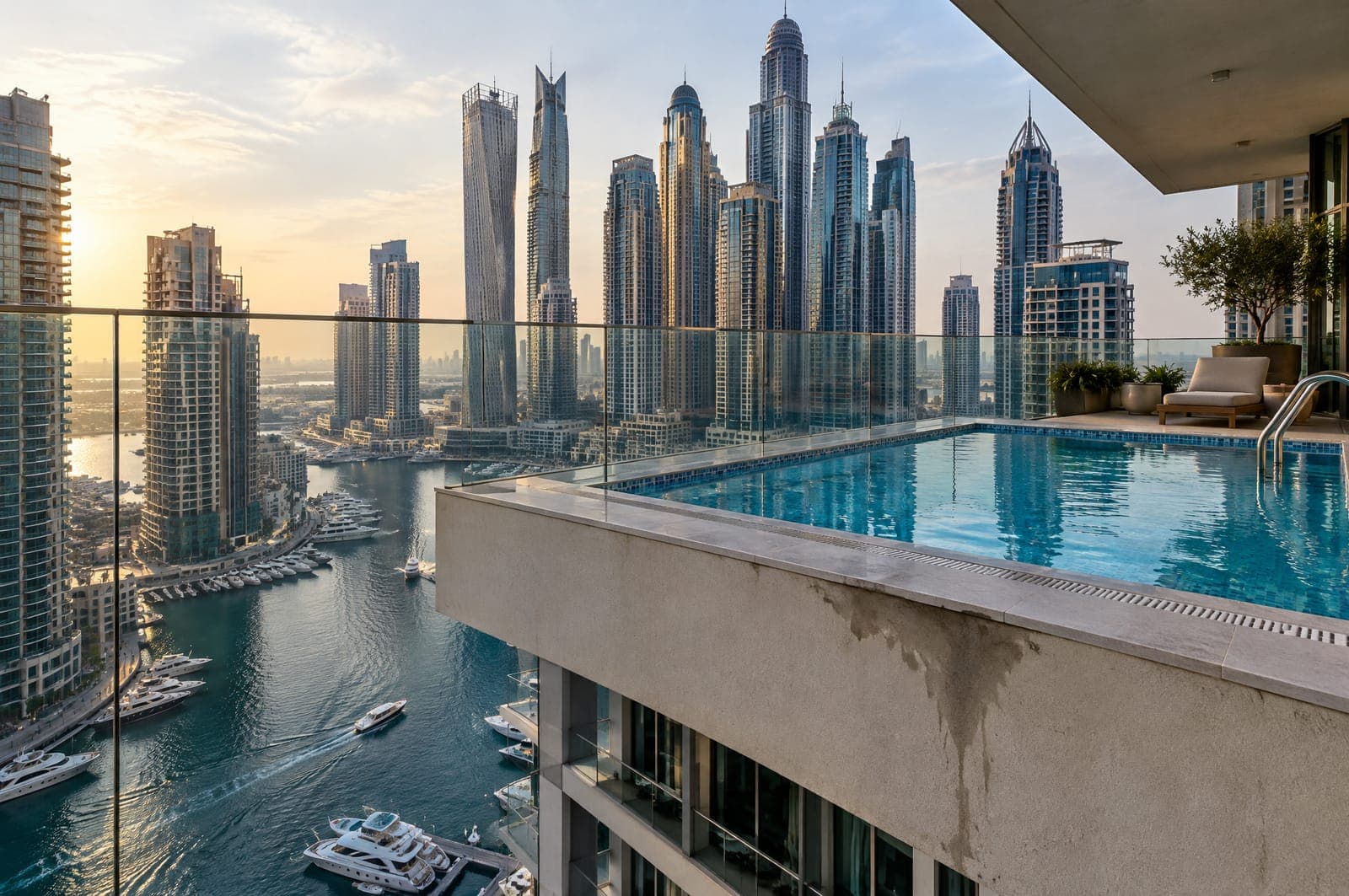
Water is coming through my ceiling under the building pool. Who fixes it?
In a jointly owned building in Dubai, the shared pool is normally a common part, and the management entity is responsible for maintaining and repairing it. Report the damage to building management in writing with photos and dates, and expect them to arrange a leak investigation that confirms the source before anything is opened up.
How a pool leak shows up below
Rooftop and podium pools sit directly above homes, corridors, car parks or shops. When one leaks, the first sign is usually not a falling water line but damage underneath: damp patches or stains on a ceiling, bubbling paint, drips from light fittings or a ceiling that sags after rain or heavy pool use.
The stain is not always directly under the leak. LeakTronics, a maker of leak detection equipment, points out that water travels before it surfaces, so a wet spot can appear some distance from where the water escapes. Water in a ceiling can also come from air conditioning drains, a bathroom in the flat above or rain getting through the roof. Pool water is one possible source among several, which is why the first job is to confirm it.
Who is responsible in a jointly owned building
In Dubai, Law No. 6 of 2019 on jointly owned real property sets the framework. Its main points for a leaking pool are these.
- The pool is usually a common part. Article 7 lists recreational facilities, swimming pools and gardens among the common parts of a building, unless the site plan says otherwise.
- The management entity maintains common parts. Depending on the type of project, the developer, a management company or a company contracted through RERA is responsible for the management, operation, maintenance and repair of common parts. The owners committee is there to check that this happens.
- The building is insured. Article 41 requires the management entity to insure the jointly owned property, including liability for damage and bodily injury to occupants or third parties, with the premiums included in service charges.
- Complaints have a route. If the management entity does not deal with a complaint within 14 days, it can be taken to RERA. Disputes under the law go to the Rental Dispute Settlement Centre.
- Developers carry defect liability. For structural defects the developer remains liable for ten years from the completion certificate, and for defective installations such as mechanical, electrical and sanitary works for one year from handover.
Two exceptions matter. A private pool on a penthouse terrace may belong to the unit rather than the common parts, so check the site plan and the Building Management Regulation. And an occupant who makes substantial alterations without approval must remedy any resulting damage at their own expense.
Other emirates have their own property laws, so the details differ outside Dubai. The principle that shared facilities are maintained by whoever manages the building is common, but confirm it for your emirate.
What affected residents should do
- Report it in writing to building management, with photos, the date the damage first appeared and how it has changed.
- Note patterns. Does the damp grow after the pool is busy, after it is topped up, or after rain? Those notes help the investigator.
- Keep away from wet electrics. If water is near ceiling lights or sockets, do not touch them. Ask building management to have a qualified electrician isolate the circuit.
- Do not open the ceiling yourself. Leave investigation and repair to the people responsible, so the cause is documented properly.
What a leak investigation involves
A competent investigation starts with the question of source, then narrows down.
- Confirm and measure the loss. With the auto fill switched off, the specialist measures how much water the pool loses. If the pool has an overflow edge, the level to watch is in the balance tank.
- Compare pump on and pump off. LeakTronics notes that losing more water with the pump running often points to the return lines, and losing more with it off often points to the suction side.
- Let the level drop and see where it stops. If the level stops at a skimmer, a light or a return fitting, that fitting is the prime suspect.
- Inspect the usual leak points. In LeakTronics' experience the most common points are the skimmer, the plumbing, light niches and return fittings.
- Dye test suspected spots and pressure test each pipe line separately to show which line leaks.
- Check the waterproofing. If the shell and pipework test tight, attention moves to the waterproofing under and around the pool, the deck drainage and the plant room.
Pools in residential buildings count as public pools under Dubai Municipality's guidelines. The operator must make sure competent persons carry out maintenance, that work follows the manufacturer's instructions and permit to work procedures, and that damaged parts of the pool are repaired or replaced immediately. Work that changes the pool itself may need approval, so expect the building's manager to coordinate this.
Why speed matters
A leak above occupied space keeps causing damage as long as the pool is in use. Push for the investigation to start promptly, ask for the findings in writing, and keep your own record of damage and dates until the repair is confirmed and the ceiling has dried out.
How this connects
- Problems and parts it covers
- Balance tank (source)
- Pressure test rig (source)
- Skimmer
- Acoustic leak detection equipment (source)
- Pipework
- Return inlets
- Main drain
- My pool is losing water
Questions people ask
Can I claim for damage to my apartment caused by the building pool?
Dubai's jointly owned property law requires the management entity to insure the building, including liability for damage to occupants and third parties. Report the damage to building management in writing and ask how a claim is handled under the building's policy.
Should the pool be closed while a leak is investigated?
That depends on how much water is escaping and where it is going. If water is reaching electrical fittings or causing active damage below, ask building management whether the pool can be taken out of use until the source is found.
Who pays if the leak comes from a private terrace pool?
A pool that belongs to a unit, rather than to the common parts, is usually the unit owner's responsibility. Check the site plan and the Building Management Regulation, which show what is a common part in your building.
Sources
- Law No. (6) of 2019 Concerning Ownership of Jointly Owned Real Property in the Emirate of Dubai, Dubai Legislation Portal, Government of Dubai. Accessed 24 Oct 2026.
- Public Swimming Pools Safety Guidelines (DM-HSD-GU81-PSPS2), version 3.0, Dubai Municipality, Health and Safety Department. Accessed 24 Oct 2026.
- How to Find a Leak in Your Pool: A Pro's Guide to Inground Pool Leak Detection, LeakTronics. Accessed 24 Oct 2026.
- Technical Guidelines for Approval of Swimming Pool Plans (DM-HSD-GU34-ASPP2), version 4.0, Dubai Municipality, Health and Safety Department. Accessed 24 Oct 2026.
Next review due 24 Apr 2027
This guide explains general principles. It is not engineering advice and cannot tell you what is wrong with a specific pool. Rules change: check with the authority named in the sources before relying on them.