Checklist
Checking the pool before you buy or rent a villa in the UAE
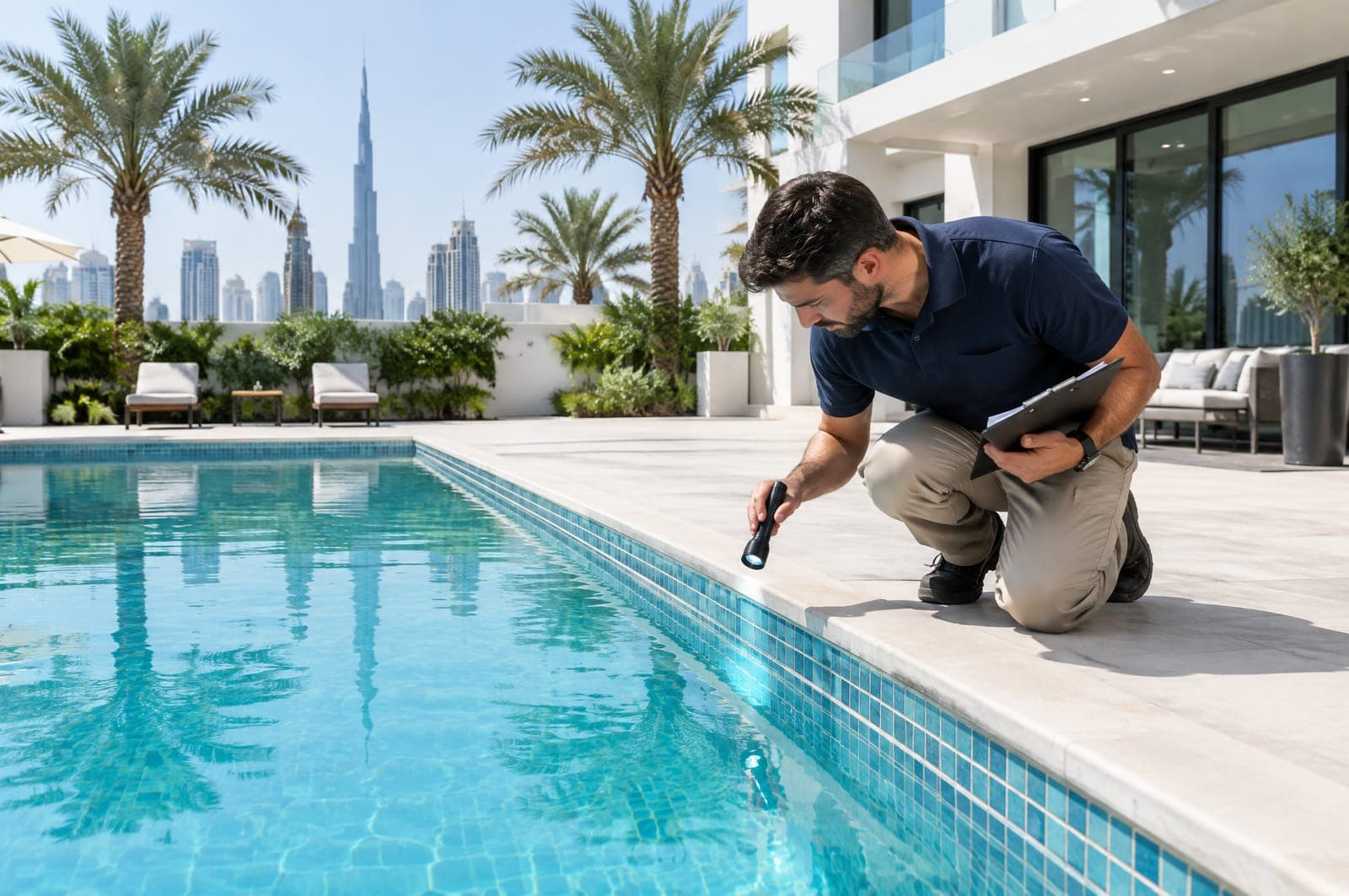
What should I check about the pool before I buy or rent a villa?
Look at the water, the shell, the enclosure and the plant room, and ask for the pool's registration, maintenance records and repair history. In Dubai the owner is responsible for keeping a private pool registered, safe and maintained, so gaps in the paperwork are worth taking seriously. If you see water loss, cracks, damp or tired equipment, book a professional inspection before you commit.
Why the pool deserves its own check
A pool is one of the few parts of a villa where serious problems hide under water, behind tiles and underground. It also comes with obligations. Dubai Municipality's guideline for private villa pools says the owner must make sure the pool is properly designed, registered with Dubai Municipality, equipped with the required safety measures, and properly maintained and operated. The occupier, whether owner or tenant, has duties too, including keeping water quality and hygiene in order and checking the enclosure and safety devices regularly.
If you buy, those duties become yours. If you rent, the tenancy contract decides who pays for what, and the condition of the pool on the day you move in becomes the benchmark when you move out. Either way, an hour spent on the pool before signing is time well spent.
What to look at on a viewing
Ask for the pump to be running when you arrive, then work through the pool from the water outwards.
- The water. It should be clear, with the floor and main drain easy to see. Dubai Municipality requires private pool water to be clear and free of floating debris, turbidity and algae. Green or cloudy water on a viewing tells you about recent care, and sometimes about the equipment.
- The water line and tiles. Look for a tide mark well below the tile line, loose or missing tiles, hollow patches and cracks in the shell or coping.
- The deck and surroundings. Check for settlement, cracked paving, damp patches in the garden and wet areas between the pool and the plant room.
- The skimmers and fittings. Skimmer lids and baskets should be intact, and drain covers secure.
- The enclosure. Dubai Municipality requires every private villa pool to have a permanent enclosure that cannot be removed without tools. Solid walls and fences must have an effective height of at least 1.20 metres, and the guideline sets detailed limits on gaps and gate latches. A pool open to the garden or the house is a safety issue and a compliance issue.
- Signage and rescue items. The guideline also calls for CPR signage, emergency numbers and a pole or scoop within reach of the pool.
- The plant room. Listen to the pump, look for drips, salt crust or corrosion at unions and valves, read the filter pressure gauge and photograph the equipment labels. Pool chemicals should be in a dedicated, lockable store.
- The lights. Ask for them to be switched on. A light that does not work or has water behind the lens needs a qualified electrician, not a quick fix.
If you have test strips, a quick reading helps. The US Centers for Disease Control and Prevention (CDC) recommends a pH of 7.0 to 7.8 and at least 1 ppm free chlorine in pools.
Questions for the seller or landlord
- Is the pool registered with Dubai Municipality, and were any changes approved? The private pool guideline says villa pools must be registered before construction, and must not be altered (for example with a diving board or slide) without approval.
- Who maintains it, how often, and can I see the logbook? Dubai Municipality requires pH, chlorine and temperature to be tested daily before use, calcium hardness, alkalinity, saturation index and cyanuric acid every 15 days, and microbiological tests every two months, with readings recorded in a logbook. A complete log is a good sign. No log at all is a question worth asking.
- How often is water added? Frequent topping up can point to a leak.
- What has been repaired, and when? Ask for invoices, leak detection reports and any warranties.
- How old is the equipment, and when was it last serviced? The guideline requires equipment to be serviced in line with the manufacturer's instructions.
- For newer homes in a jointly owned development: Dubai Law No. 6 of 2019 makes developers liable for structural defects for ten years from the completion certificate, and for defective installations such as mechanical, electrical and sanitary works for one year from handover. Ask whether the property falls under that law and what remains of those periods.
When to get a professional inspection
Book a pool specialist or a leak detection specialist before you commit if:
- the water line is well below the tiles or the seller mentions regular topping up
- you see cracks in the shell, lifting tiles or damp ground near the pool
- the equipment is old, noisy or leaking, or the records are thin
- the pool has an overflow or infinity edge, which hides water loss in a balance tank
A specialist can measure water loss, inspect fittings and test pipe lines. Some tests need the pool undisturbed for a few days, so build that time into your offer or lease negotiation.
Tenants: record the handover
Under Dubai's tenancy law (Law No. 26 of 2007), the landlord is responsible for maintenance works and for repairing defects that affect the tenant's intended use, unless the parties agree otherwise. The tenant must look after the property as an ordinary person would look after their own, may not carry out maintenance or changes without the landlord's permission, and must return the property in the condition it was received, apart from ordinary wear and tear.
That makes the move in record important. Photograph and film the pool, the water, the tiles and the plant room, note the filter pressure, and get the agreed maintenance arrangement written into the contract. Other emirates have their own tenancy rules, so check the law that applies where the villa is.
How this connects
- Signs you may notice
- Pool light not working
- Water inside the pool light
- Tripping breaker or earth leakage device
- Green water
- Cloudy water
- Possible causes
- Water balance out of range
- Low free chlorine
- Evaporation
- Air leak on the suction side
Questions people ask
Who pays for pool maintenance in a rented villa in Dubai?
Dubai's tenancy law makes the landlord responsible for maintenance works unless the parties agree otherwise, and a contract can shift routine pool care to the tenant. Read the contract and get the pool arrangement written in before you sign.
Is a viewing enough to spot a leaking pool?
Rarely. A leak often only shows over days, through a falling water line or frequent top ups. If anything looks wrong, a leak detection specialist can measure the loss and test the pipe lines before you commit.
Does a villa pool need a fence in Dubai?
Yes. Dubai Municipality requires every private villa pool to have a permanent enclosure that cannot be removed without tools, and solid walls and fences must be at least 1.20 metres high. A safety cover or net is recommended as an additional layer of protection.
Sources
- Private Swimming Pools Safety Guidelines (DM-HSD-GU80-PRSPS2), Dubai Municipality, Health and Safety Department. Accessed 24 Oct 2026.
- Technical Guidelines for Approval of Swimming Pool Plans (DM-HSD-GU34-ASPP2), version 4.0, Dubai Municipality, Health and Safety Department. Accessed 24 Oct 2026.
- Law No. (26) of 2007 Regulating the Relationship between Landlords and Tenants in the Emirate of Dubai, Dubai Legislation Portal, Government of Dubai. Accessed 25 Oct 2026.
- Law No. (6) of 2019 Concerning Ownership of Jointly Owned Real Property in the Emirate of Dubai, Dubai Legislation Portal, Government of Dubai. Accessed 24 Oct 2026.
- Home Pool and Hot Tub Water Treatment and Testing, US Centers for Disease Control and Prevention (CDC). Accessed 25 Oct 2026.
Next review due 24 Apr 2027
This guide explains general principles. It is not engineering advice and cannot tell you what is wrong with a specific pool. Rules change: check with the authority named in the sources before relying on them.