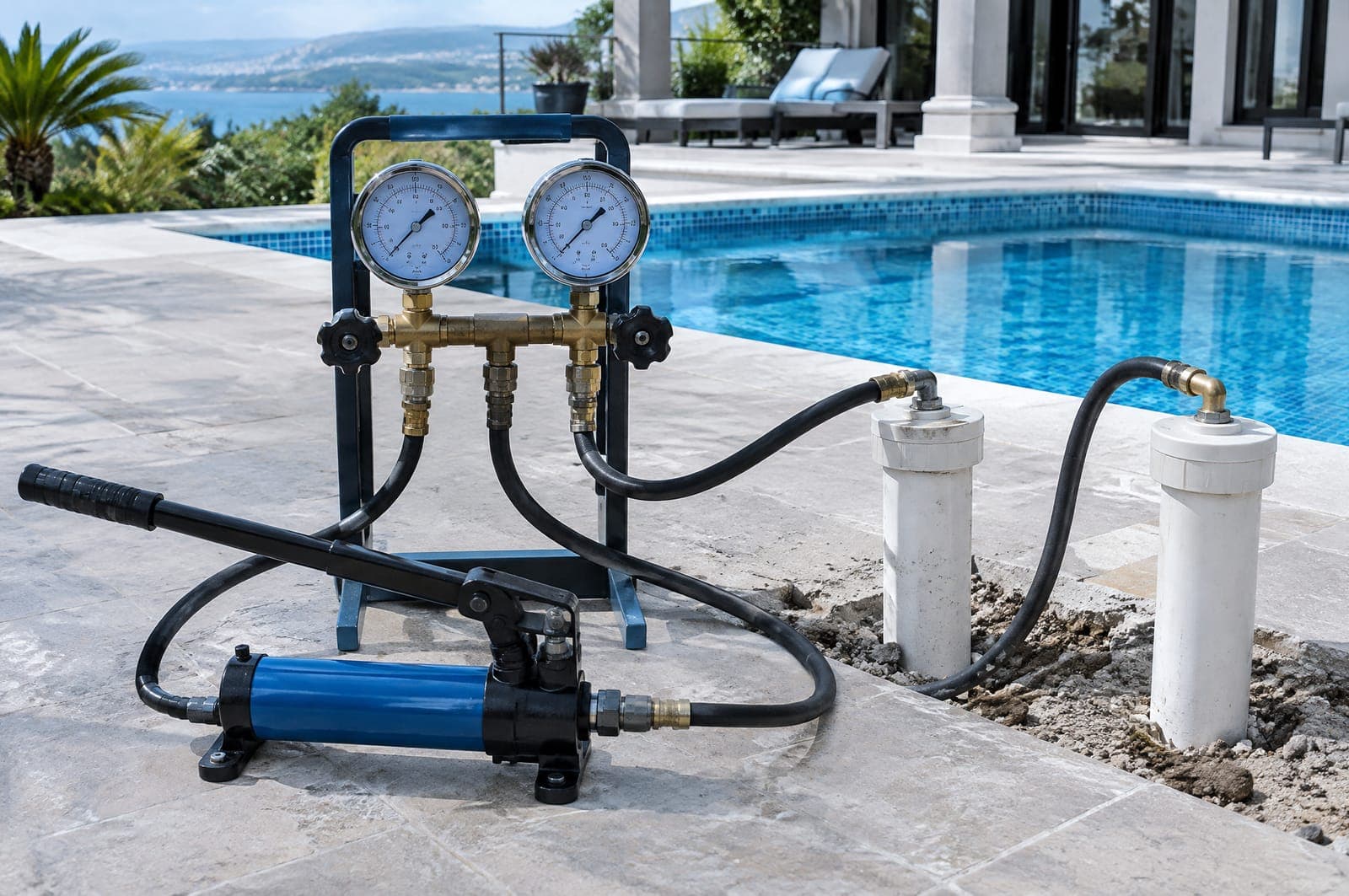
Pressure testing
Pressure testing isolates each pipe in a pool's circulation system and pressurises it to prove whether that line holds or leaks. It tells a specialist which buried pipe is at fault and is usually part of a wider leak search.
When you need it
- The pool is losing water and the shell, fittings and equipment show no obvious leak.
- The pump struggles to prime or flow is weak. Pentair's pump manual lists air leaks in the suction piping as a cause of both.
- You see wet patches, settling paving or soft ground along the route of a pipe.
- A pipe has just been repaired and the repair needs to be proven before the surface is closed.
- A new or renovated pool is about to be handed over and the lines need to be confirmed tight.
How a specialist does it
LeakTronics describes the routine for hydrostatic testing of pool lines:
- Shut down and isolate. The pump is switched off and the equipment pad isolated. The test never runs through the pump, filter or heater.
- Plug each line. The pool end of each pipe is sealed with test plugs, and valves at the pad are closed so one line is tested at a time.
- Fill and bleed. The line is filled with clean water and air is bled from high points, because trapped air throws off the gauge.
- Pressurise slowly to the chosen test pressure using a rig with valves and a gauge.
- Hold and watch. The gauge is watched for any drop over the test period while visible fittings are inspected.
- Record and restore. Results are logged for each line, then pressure is released, plugs removed and the system restored.
If the pressure holds, the line is tight. If it drops, that line leaks. Before calling it, a careful technician retests to rule out a leaking plug, a valve that will not seal or temperature change in the line.
Locating the exact spot is a separate step. LeakTronics explains why two media are used. Water is used to test because it barely compresses and gives a steady reading. Low-pressure air is used to locate: air escaping from the break makes a sound a ground microphone can hear through deck or soil. A line locator first traces where the pipe actually runs. The aim is to open one spot rather than dig a trench.
What to ask before you hire
- Will you test every line separately: skimmers, main drain, returns, and any water feature or overflow lines?
- What test pressure and duration do you use for my pipe sizes, and why?
- How do you rule out a faulty plug or valve before declaring a line failed?
- Can you trace the pipe route and pinpoint the leak, or only confirm which line fails?
- Will I get the result for each line in writing?
- Is repair quoted separately once the location is known?
UAE notes
Many villa pools have the equipment room some distance from the pool, with paving, planting or hardscape over the pipe route. Ask the specialist where they would expect to open if a line fails, and who reinstates the surface.
For pools in towers or on podiums, pipework can pass through shared areas or other units. Check with building management about access and permissions before testing or opening up anything.
Dubai Municipality's guidelines for approving pool plans list a pipe fitting layout for the pool and pump room among the required drawings. If you have the approved drawings for your pool, share them with the specialist: they save time and guesswork.
Questions people ask
Is pressure testing the same as leak detection?
It is one method within a leak search. Pressure testing focuses on the pipes, while a full search also covers the shell, fittings and equipment.
Why test with water and locate with air?
LeakTronics explains that water barely compresses, so it gives a clean gauge reading for the test. Low-pressure air escaping from a break makes a sound that listening equipment can pick up, which helps find the exact spot.
Does a failed test mean the deck must be opened?
Not necessarily along the whole run. The pipe route is traced and the leak located first, so that any opening is targeted. Relining is sometimes an alternative.
Sources
- What Is a Hydrostatic Test? Hydrostatic Pressure Testing for Pool Pipes and Plumbing, LeakTronics. Accessed 25 Oct 2026.
- SuperFlo Pump Installation and User's Guide (DOE compliant), Pentair. Accessed 25 Oct 2026.
- Technical Guidelines for Approval of Swimming Pool Plans (DM-HSD-GU34-ASPP2), version 4.0, Dubai Municipality, Health and Safety Department. Accessed 25 Oct 2026.
General information, not engineering advice. Only an inspection tells you what is wrong with a specific pool.
Specialists for pressure testing
Al Qamar Pools
Ras Al Khaimah
Unclaimed listing- Pressure testing (stated by public sources, unconfirmed)
Austenite Technical Services LLC
Al Thanyah 1, Dubai
Unclaimed listing- Pressure testing (stated by public sources, unconfirmed)
Green Creation
Dubai
Unclaimed listing- Pressure testing (stated by public sources, unconfirmed)
- Unclaimed listing
- Pressure testing (stated by public sources, unconfirmed)
Under Water Pool Specialist
Umm Al Quwain
Unclaimed listing- Pressure testing (stated by public sources, unconfirmed)
Cornerstone Middle East
Port Saeed, Dubai
Unclaimed listing- Pressure testing (stated by public sources, unconfirmed)