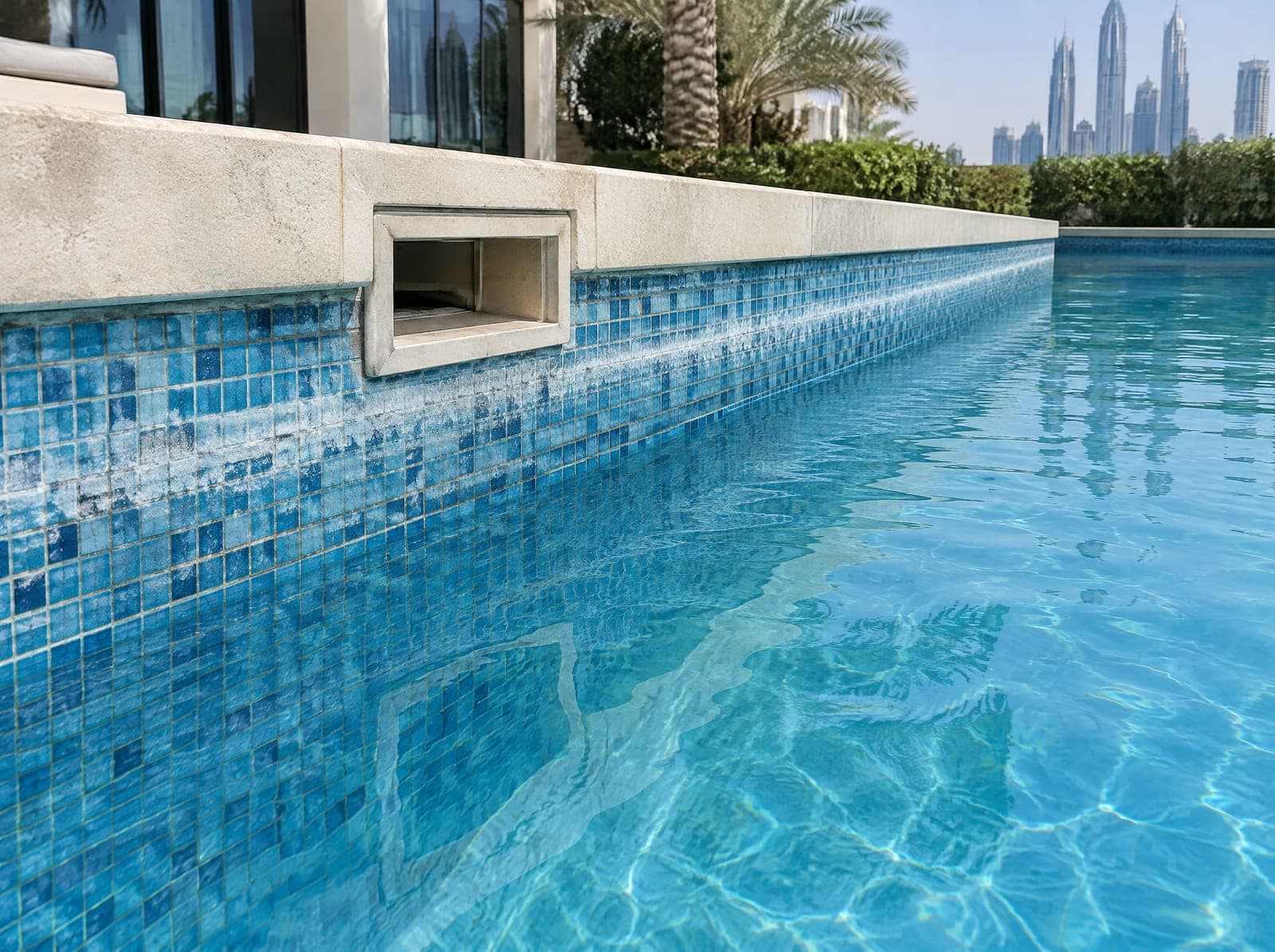
My pool is losing water
Every outdoor pool loses some water to evaporation, and in a UAE summer that loss can be noticeable. A drop that is faster than usual, or that carries on when the weather cools, can point to a leak in the shell, a fitting or the pipework. This page explains what to look for, what you can safely record yourself and what a leak detection specialist will usually do.
What you might notice
- The water level drops faster than it used to, or you top up more often.
- An automatic top-up runs more than usual, or the water bill rises without a clear reason.
- Damp patches, soft ground or standing water near the pool, the plant room or along pipe routes.
- Air bubbles in the pump strainer basket, or the pump losing prime.
- Loose or hollow tiles, or cracks in the shell or the surround.
- White crusty deposits on pipes or fittings, which the City of Scottsdale's water conservation guidance names as a possible sign of a slow leak.
Common causes
Evaporation is the first thing to rule out. It rises with sun, wind and warm water, so a pool can lose more on a hot, windy day than on a still one. Scottsdale's guidance recommends a pool cover to reduce evaporation.
When the loss is more than evaporation, the water usually escapes at one of a few places. Leak detection guidance from LeakTronics, a supplier of leak detection equipment, points to skimmers, underwater lights and other fittings as common locations, along with the plumbing lines. Scottsdale's guidance states that most pool leaks are found in the pool equipment.
Other causes can include:
- Cracks in the concrete shell, or failed waterproofing behind the tiles.
- Gaps where fittings pass through the shell, such as returns, main drains and light niches.
- Leaking valves, unions or seals in the plant room.
- A backwash valve that lets water pass to waste.
- In overflow and infinity pools, a fault in the balance tank, its top-up valve or its level control, which can look like a leak in the pool itself.
What you can safely check yourself
These steps are observation only. Do not open electrical equipment, and do not lower or drain the pool to look for a leak.
- Note the water level daily. Mark the level on a tile or in the skimmer at the same time each day and write it down with the date.
- Try a bucket comparison. Scottsdale's guidance describes filling a bucket to pool water level, marking both levels and comparing them after two to three days. If the pool drops more than the bucket, the extra loss suggests a leak.
- Compare pump on and pump off. The same guidance suggests repeating the test with the pump running and then off, using its normal controls. A greater loss with the pump running suggests the plumbing rather than the structure.
- Look around without touching. Photograph damp patches, cracks, loose tiles and any water on the plant room floor.
- Read the water meter. If you can, note the reading over a period when no one uses water, so the specialist has a figure to work with.
What a specialist will usually do
A leak detection specialist will usually start by confirming that there is a leak and how fast the water is going. They then narrow it down. LeakTronics describes water level tests to isolate areas, dye testing at suspect fittings and pressure testing of individual plumbing lines. Many specialists also use listening equipment to trace leaks in buried pipes.
Once the leak is found, the repair depends on where it is. A fitting may need resealing, a pipe section may need replacing, or an area of tiles and waterproofing may need renewing. Some specialists only find leaks and hand the repair to another contractor, so ask which they offer.
What to prepare before you call
- Your daily level notes and the bucket test results.
- The pool type and finish, and its approximate size and depth.
- Whether the pool has skimmers or an overflow channel with a balance tank.
- Photos of the plant room, the equipment and any damp or cracked areas.
- Any recent work on the pool, the garden or nearby plumbing.
- For buildings and communities, who controls access to the plant room and the roof.
Questions people ask
How much water loss is normal?
It varies with sun, wind and humidity, so no single figure fits every pool. A bucket comparison over two or three days is a simple way to separate evaporation from a possible leak, because the bucket loses water to evaporation at a similar rate to the pool.
Should I drain the pool to find the leak?
No. Draining can damage some pools, especially fibreglass and vinyl liner pools, and it removes the water level evidence a specialist relies on. Keep the pool at its normal level and leave any lowering to the specialist.
Can the leak be in the equipment rather than the pool?
Yes. Pumps, filters, valves and plant room pipework can all leak, and Scottsdale's guidance says most pool leaks are found in the equipment. Comparing the loss with the pump running and switched off helps show whether the circulation system is involved.
Who should I contact first?
A leak detection specialist. Many also carry out the repair. Others report where the leak is so that a repair contractor can fix it.
Sources
- Water Conservation for Homeowners (Water and my pool), City of Scottsdale. Accessed 25 Oct 2026.
- How to Find a Pool Leak in Your Inground Pool, LeakTronics. Accessed 25 Oct 2026.
General information, not engineering advice. Only an inspection tells you what is wrong with a specific pool.
Specialists who deal with this
All 55Al Qamar Pools
Ras Al Khaimah
Unclaimed listing- Leak detection (stated by public sources, unconfirmed)
- Pressure testing (stated by public sources, unconfirmed)
- Pipe repair (stated by public sources, unconfirmed)
- Waterproofing (stated by public sources, unconfirmed)
Under Water Pool Specialist
Umm Al Quwain
Unclaimed listing- Leak detection (stated by public sources, unconfirmed)
- Pressure testing (stated by public sources, unconfirmed)
- Pipe repair (stated by public sources, unconfirmed)
- Tile and mosaic repair (stated by public sources, unconfirmed)
Austenite Technical Services LLC
Al Thanyah 1, Dubai
Unclaimed listing- Leak detection (stated by public sources, unconfirmed)
- Pressure testing (stated by public sources, unconfirmed)
- Pipe repair (stated by public sources, unconfirmed)
Green Creation
Dubai
Unclaimed listing- Leak detection (stated by public sources, unconfirmed)
- Pressure testing (stated by public sources, unconfirmed)
- Waterproofing (stated by public sources, unconfirmed)
- Tile and mosaic repair (stated by public sources, unconfirmed)
- Unclaimed listing
- Leak detection (stated by public sources, unconfirmed)
- Pressure testing (stated by public sources, unconfirmed)
- Pipe repair (stated by public sources, unconfirmed)
Altaif Pool Cleaning
Al Murar, Dubai
Unclaimed listing- Leak detection (stated by public sources, unconfirmed)
- Pipe repair (stated by public sources, unconfirmed)
- Waterproofing (stated by public sources, unconfirmed)
- Tile and mosaic repair (stated by public sources, unconfirmed)
Dream Pool Dubai
Business Bay, Dubai
Unclaimed listing- Leak detection (stated by public sources, unconfirmed)
- Pipe repair (stated by public sources, unconfirmed)
- Waterproofing (stated by public sources, unconfirmed)
- Tile and mosaic repair (stated by public sources, unconfirmed)
Mari Gold Pools Services LLC-S.P.C
Musaffah, Abu Dhabi
Unclaimed listing- Leak detection (stated by public sources, unconfirmed)
- Pipe repair (stated by public sources, unconfirmed)
- Waterproofing (stated by public sources, unconfirmed)
- Tile and mosaic repair (stated by public sources, unconfirmed)
- Unclaimed listing
- Leak detection (stated by public sources, unconfirmed)
- Pipe repair (stated by public sources, unconfirmed)
- Waterproofing (stated by public sources, unconfirmed)
- Tile and mosaic repair (stated by public sources, unconfirmed)
MNT Pools
Dubai
Unclaimed listing- Leak detection (stated by public sources, unconfirmed)
- Pipe repair (stated by public sources, unconfirmed)
- Waterproofing (stated by public sources, unconfirmed)
- Tile and mosaic repair (stated by public sources, unconfirmed)