Leak detection
Leak detection is the work of finding exactly where a pool loses water: through the shell, a fitting, the pipework or the equipment. It suits owners and managers who see the level dropping faster than evaporation explains and want the fault located before anyone breaks tiles or opens a deck.
When you need it
In UAE heat a pool always loses some water to evaporation. A leak shows up as loss beyond that, and as a pattern rather than one bad day. LeakTronics, a maker of leak detection equipment, lists the signs specialists look for:
- you top up far more often than you used to
- the auto-fill runs constantly or the water bill jumps
- you need more chemicals than usual to keep the water balanced
- the level drops noticeably overnight
- new cracks, loose tiles or soggy ground appear around the pool
DEWA suggests a simple check for any property: switch off all water devices and look at the meter. If it still runs, there is a leak somewhere in the pipes or system. DEWA also recommends covering a pool to reduce evaporation, which makes any later comparison more meaningful.
How a specialist does it
A good leak search moves from the obvious to the precise. In general terms:
- Equipment check. Drips at the pump lid, shaft seal and unions, worn O-rings on the filter, backwash valves and the auto-fill are ruled out first.
- Watching the level. If the water is allowed to drop, where it stops is a clue: at the skimmer, the light, a return fitting, or not at all.
- Close inspection. Skimmers, lights, returns, steps, benches and the shell are inspected up close, often in the water.
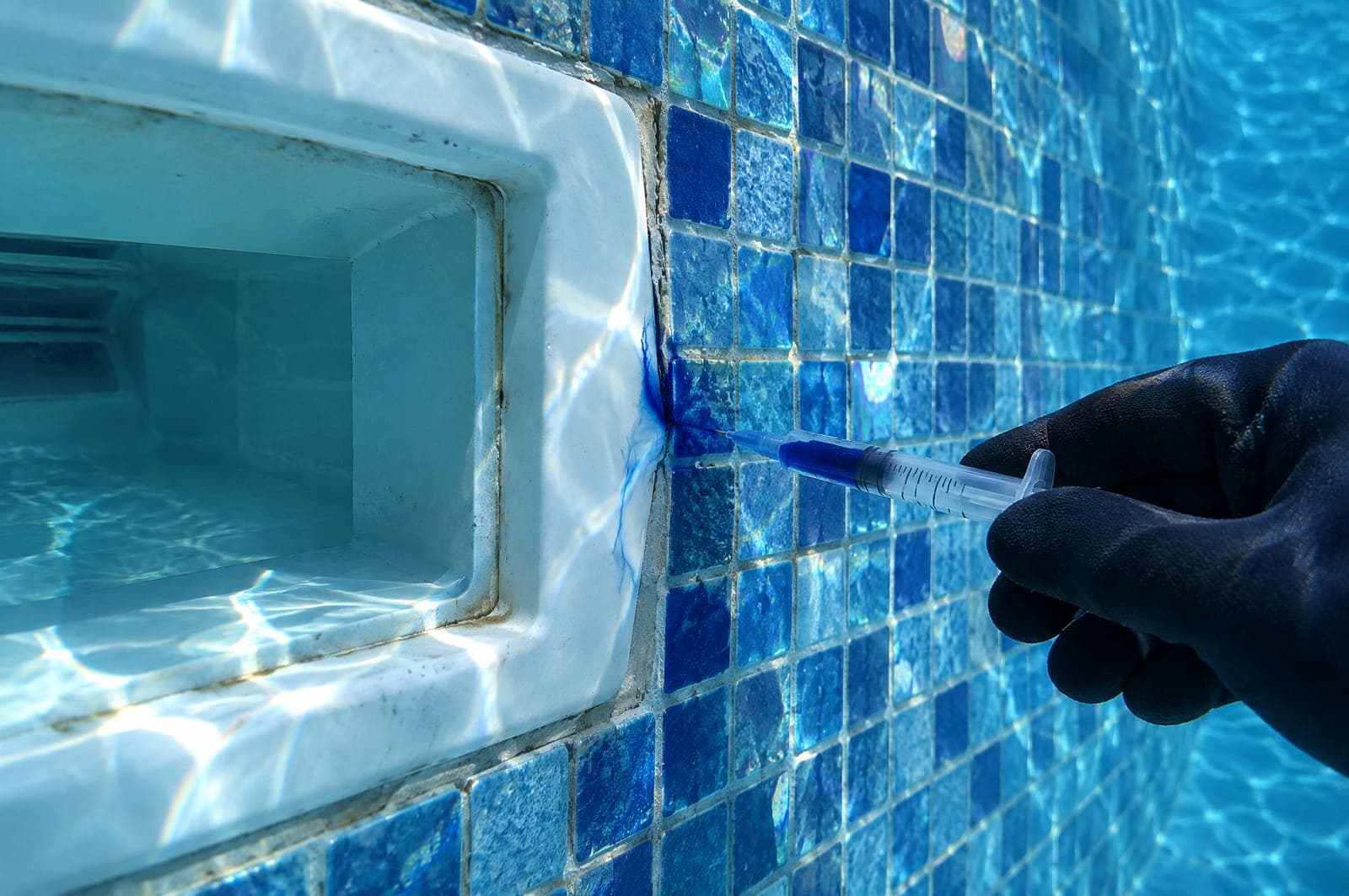
- Dye testing. With the pump off and the water still, a small stream of dye is released next to a suspected spot. If the dye is drawn in, the leak is confirmed there. LeakTronics notes that movement in the water is the main reason dye tests fail.
- Pressure testing the lines. Each pipe is isolated and pressurised to see which one loses pressure. This has its own service page.
- Acoustic location. Hydrophones in the water and ground microphones on the deck or soil listen for water or air escaping from a crack, pinhole or separated joint.
LeakTronics observes that most pool leaks happen within a few feet of the pool itself: fittings, skimmers, lights and cracks. That is why the inspection stage matters as much as the equipment.
The outcome should be a written finding: where the leak is, how it was confirmed, and what repair is proposed. Detection and repair are sometimes done by the same company and sometimes by different ones.
What to ask before you hire
- Which methods will you use, and in what order?
- Do you test the shell, the pipework and the equipment, or only one of them?
- Will I get a written report with the location marked and photos?
- If the leak is in a pipe under the deck, how do you pinpoint it before opening anything?
- Do you also repair, and is the detection visit charged separately?
- What happens if you cannot find a leak on the first visit?
UAE notes
Summer evaporation is high, so a single reading in July says little. Compare over several days, with the cover on if you have one, and note any auto-fill activity during that time.
Overflow and infinity pools add an overflow channel, a balance tank and a top-up system to the search. A leak can hide in any of them, so ask whether the specialist has worked on this type of pool before.
In towers and communities, access to plant rooms, lower floors or shared areas usually goes through building management. Check with them before booking, especially if a pipe may run through a podium or above someone else's ceiling.
Questions people ask
Is some water loss normal?
Yes. Evaporation takes water every day, more so in summer. Loss beyond that, more frequent top-ups, rising chemical use or wet ground around the pool are reasons to have it checked.
Can a leak be found without breaking tiles?
Specialists use inspection, dye, pressure tests and listening equipment to locate a leak first, so that any opening is small and in the right place.
Does Dubai Pool Pros find the leak?
No. Dubai Pool Pros lists specialists and passes your enquiry on. The inspection and any diagnosis are done by the business you choose.
Sources
- How to Find a Leak in Your Pool: A Pro's Guide to Inground Pool Leak Detection, LeakTronics. Accessed 25 Oct 2026.
- Pool Leak Detection Dye: How to Dye Test a Swimming Pool Like a Pro, LeakTronics. Accessed 25 Oct 2026.
- General Tips, Dubai Electricity and Water Authority (DEWA). Accessed 25 Oct 2026.
General information, not engineering advice. Only an inspection tells you what is wrong with a specific pool.
Specialists for leak detection
All 50Aquify
Abu Hail, Dubai
Unclaimed listing- Leak detection (stated by public sources, unconfirmed)
Desert Leisure
Nadd Al Hamar, Dubai
Unclaimed listing- Leak detection (stated by public sources, unconfirmed)
Infinite Leisure Pools
Abu Hail, Dubai
Unclaimed listing- Leak detection (stated by public sources, unconfirmed)
Pool Masters
Al Quoz, Dubai
Unclaimed listing- Leak detection (stated by public sources, unconfirmed)
Al Qamar Pools
Ras Al Khaimah
Unclaimed listing- Leak detection (stated by public sources, unconfirmed)
Alfenon Aljameela Swimming Pool Installation L.L.C.
Al Garhoud, Dubai
Unclaimed listing- Leak detection (stated by public sources, unconfirmed)
Altaif Pool Cleaning
Al Murar, Dubai
Unclaimed listing- Leak detection (stated by public sources, unconfirmed)
ArabCare
Al Barsha, Dubai
Unclaimed listing- Leak detection (stated by public sources, unconfirmed)
Austenite Technical Services LLC
Al Thanyah 1, Dubai
Unclaimed listing- Leak detection (stated by public sources, unconfirmed)
Backyard Landscape LLC
Al Quoz, Dubai
Unclaimed listing- Leak detection (stated by public sources, unconfirmed)