How it works
Pool waterproofing: what the membrane does and why it matters before re-tiling
Does a concrete pool need waterproofing before it is re-tiled?
Tiling manufacturers expect a pool to be a watertight concrete structure, and their pool systems add a flexible waterproofing membrane between the levelled shell and the tile adhesive. Before re-tiling, the shell should be tested for watertightness and any cracks investigated, because leaks are very hard to find once the new finish is on. Re-tiling over a failed membrane or a leaking shell rarely solves the problem.
Two lines of defence
A tiled concrete pool holds water in two ways. The first is the structure: a reinforced concrete shell designed and built to be watertight. The second is a waterproofing membrane applied to the inside of the shell before the tiles go on.
Mapei's technical service puts the order plainly: only watertight reinforced concrete pool shells are suitable for receiving tiles, and the shell should pass a watertightness test before tiling starts. The surfaces are then levelled and waterproofed. ARDEX UK says British Standards require swimming pools to be watertight structures, and that where a structure is not watertight, a waterproofing product must be applied over the entire area at the correct thickness, or there could be leaks that are notoriously hard to find once the installation is complete.
A membrane protects a sound shell, bridges small movements and stops water travelling behind the tiles. It cannot make up for a shell that leaks.
What the membrane is
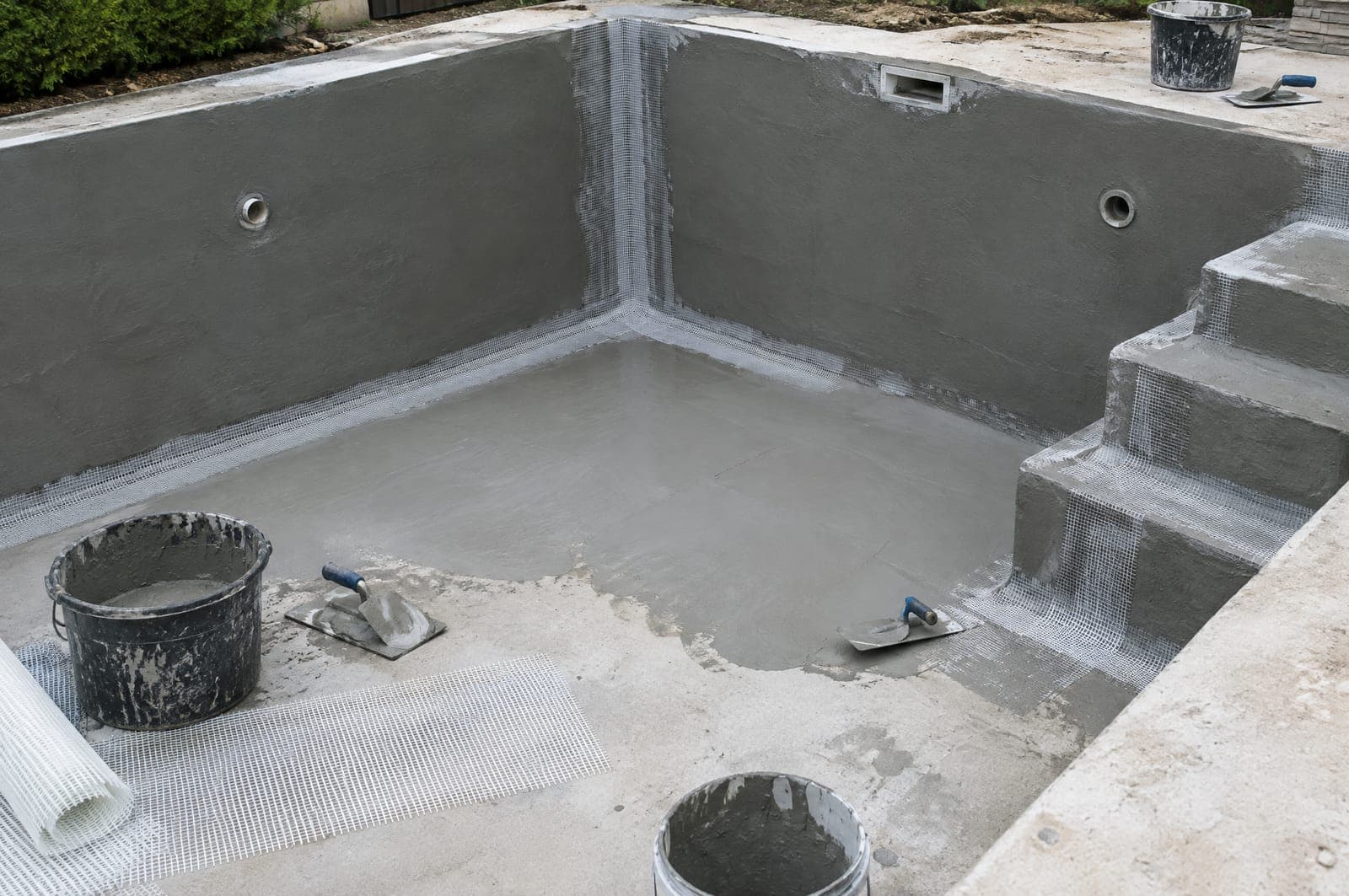
Pool membranes are usually liquid-applied. Mapei names flexible two-component cementitious membranes, applied in two coats to a total thickness of at least 2 mm, with a glass fibre mesh or fabric embedded between the coats where the pool is subject to high loads or movement. Construction Chemicals, an Australian manufacturer, specifies an acrylic membrane in two coats to a final thickness of 1.5 mm. The products differ, but the principle is the same: a continuous, flexible film built up to a specified thickness.
The details decide whether it works:
- Corners and junctions. Mapei and ARDEX both call for reinforcing tape at the joints between walls and floor.
- Penetrations. Skimmers, inlets, lights and pipes pass through the shell. Mapei lists them, together with corners, edges and cold joints, among the critical areas in pool waterproofing.
- Weather and curing. Construction Chemicals tells installers not to apply its products in direct sunlight or hot, windy conditions, and allows a minimum of seven days at 23 °C and 50 per cent relative humidity before filling. In a UAE summer that narrows the working window.
- Compatible adhesive. Over a membrane, Construction Chemicals specifies flexible adhesives, and Mapei expects adhesives and grouts suited to contact with chlorinated water.
What an internal membrane is not designed for
Construction Chemicals warns against using its internal membrane on inground concrete pools subject to negative or hydrostatic back pressure, meaning groundwater pushing from outside. Mapei offers a separate cementitious mortar for concrete under negative and positive hydraulic pressure. If your pool sits in high groundwater, the specialist has to design for it rather than reuse a standard internal system.
Mapei's waterproofing product manager also makes a point that applies to every renovation: cracks in an existing structure may be a sign of settlement, so look into them carefully before any waterproofing work.
Signs the waterproofing may have failed
No single symptom proves it. These signs point towards the shell or membrane rather than the plumbing, and justify an investigation:
- the pool loses more water than evaporation explains, and the loss continues with the pump switched off (see why is my pool losing water)
- pressure tests on the pipework pass, but the pool still loses water
- tiles sound hollow, lift or fall off across an area rather than one or two at a time
- damp patches appear on walls next to the pool, in the plant room or, for rooftop and podium pools, in the space below
- grout keeps cracking or washing out along the same lines
A leak detection specialist can rule out the pipework and fittings first, so that the shell is only opened up when the evidence points there.
Why it matters before re-tiling
Re-tiling is the moment the membrane can be reached. Once new tiles are bonded, the only way back to it is to remove them again. The ARDEX warning about leaks being hard to find after installation is the practical reason to deal with waterproofing during a renovation rather than after it.
Before agreeing to a re-tiling quote, ask the contractor to answer in writing:
- Will the old tiles and adhesive be removed down to the shell?
- Will the shell be inspected and tested for watertightness before new work starts?
- How will cracks found in the shell be assessed and repaired?
- Which membrane will be used, in how many coats and to what thickness?
- How will corners, skimmers, inlets, lights and pipe penetrations be detailed?
- How long will the membrane cure before tiling, and before filling?
- Which adhesive and grout will go over it, and are they compatible with it?
Put the answers into the quote itself. Our guide to warranties and written quotes covers what else to ask for.
How this connects
- Problems and parts it covers
- Balance tank
- My pool is losing water
- Tiles, mosaic or surface damaged
- Pool shell
- Waterproofing
- The pool needs a full renovation
- Balance tank
Questions people ask
Is the tile adhesive itself waterproof?
Tiling system manufacturers treat the membrane and the adhesive as separate layers. Mapei and Construction Chemicals specify a waterproofing membrane on the levelled shell, then an adhesive that is compatible with it and suitable for immersion.
Can a pool be waterproofed without removing the tiles?
The membrane sits between the shell and the tile adhesive, so renewing it means taking the finish off. Coatings that are left exposed do exist, but they replace the tiled finish rather than sitting behind it.
How long does a new membrane need before the pool is filled?
It depends on the product and conditions. Construction Chemicals, for example, allows a minimum of seven days at 23 °C and 50 per cent relative humidity before filling, and longer in cooler conditions. Ask your contractor for the figure in the product data sheet.
Sources
- Installing ceramic tiles in pools: application guidelines, Mapei (Realtà Mapei). Accessed 25 Oct 2026.
- Waterproofing: the secret behind the durability of swimming pools, Mapei (Realtà Mapei). Accessed 25 Oct 2026.
- The ARDEX Guide to Tiling in Swimming Pools, ARDEX UK. Accessed 25 Oct 2026.
- Waterproofing and Tiling Swimming Pools, Construction Chemicals. Accessed 25 Oct 2026.
Next review due 24 Apr 2027
This guide explains general principles. It is not engineering advice and cannot tell you what is wrong with a specific pool. Rules change: check with the authority named in the sources before relying on them.