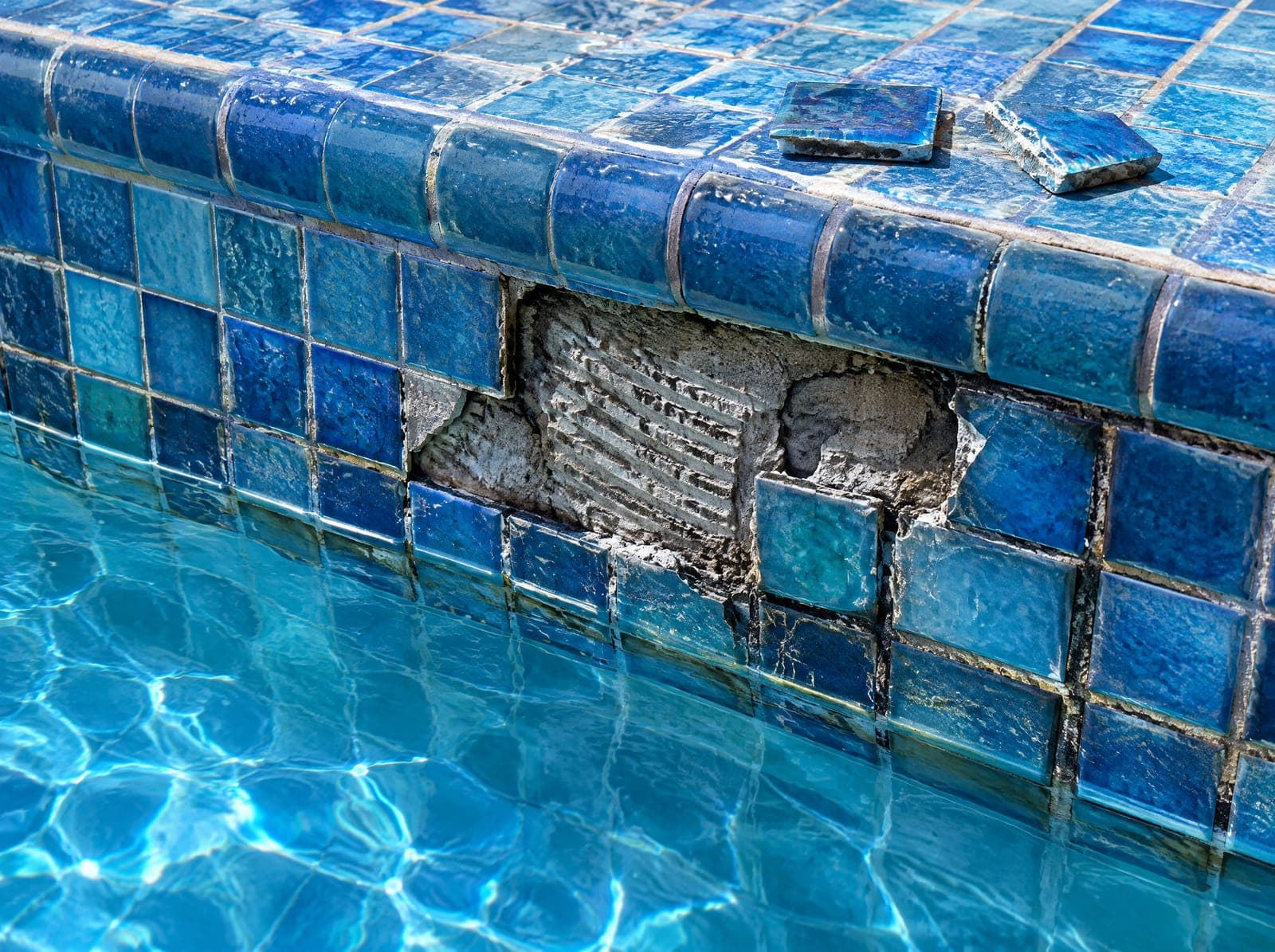
Tiles, mosaic or surface damaged
Loose tiles, cracked mosaic, missing grout or a rough, stained finish are common in older pools and in pools exposed to strong sun. Some damage is cosmetic, and some can be a sign that water is getting behind the surface. This page explains what to look for, what you can safely record and how a specialist usually approaches the repair.
What you might notice
- Tiles or mosaic sheets that are loose, hollow when tapped, cracked or missing.
- Grout that is washed out, cracked or discoloured.
- Sharp edges where pieces have come away, which can cut feet.
- Cracks in the coping, the waterline band or the pool surround.
- A rough, etched or stained plaster or pebble finish.
- Bubbling or peeling of a coating.
Common causes
A tiled pool depends on several layers working together: a watertight concrete shell, often a waterproofing membrane, a tile adhesive suited to permanent immersion, and grout. Damage in one layer often shows in the layer above it.
Manufacturer guidance shows how much depends on the original work. Instarmac's UltraTileFix guidance on tiling pools calls for low absorbency tiles, ideally under 0.5 percent absorption, a full adhesive bed without voids, planned movement joints and set curing periods before tiling and before filling. Construction Chemicals' pool tiling guide restricts glass mosaic to specified adhesives and states that correct water balance is critical to avoid maintenance problems.
Common causes can include:
- Adhesive that was not suited to immersion, or not fully bedded behind the tile.
- Missing or failed movement joints, so tiles crack as the structure moves.
- Water chemistry that is aggressive to grout and cement-based finishes over time.
- Water getting behind the tiles through cracks or failed waterproofing.
- Ageing of plaster or pebble finishes, which can etch, scale or stain.
- Work carried out in heat or direct sun. Construction Chemicals specifies application between 10 and 30 °C, and not in direct sunlight or hot, windy conditions, for its pool system. That matters in a UAE summer.
What you can safely check yourself
- Photograph the damage. Take wide shots to show the location and close-ups with something for scale.
- Mark it on a sketch. A simple plan of the pool with damaged areas marked helps a specialist quote.
- Watch the water level. If tiles are coming loose, note the level daily. A loss beyond evaporation can mean water is escaping behind the surface.
- Keep swimmers safe. If there are sharp edges, keep people away from that area until it is repaired.
Do not chip out tiles, lower the water or try to re-fix tiles underwater with general products.
What a specialist will usually do
A tile and surface specialist will usually inspect the extent of the damage and check whether the tiles around it are also hollow. They will want to know whether the shell and waterproofing are sound before re-fixing anything, because new tiles on a leaking substrate tend to fail again.
Small repairs may be possible with the pool partly lowered or with products made for underwater use. Larger areas usually mean lowering or emptying the pool, removing tiles, repairing the substrate and membrane, re-tiling with immersion-rated adhesive and grout, and allowing the curing periods the product makers set. Instarmac's guidance, for example, gives a minimum of three weeks before water is introduced into a newly tiled pool, with filling no faster than 750 mm in depth per day. Ask which times apply to the products proposed for your pool.
Dubai Municipality's safety guidelines for private pools state that damaged parts of a pool should be repaired or replaced immediately, which is a good reason not to leave sharp or loose tiles for later.
What to prepare before you call
- Photos and your sketch of the damaged areas.
- The tile or mosaic type and size, and any spare tiles from the original build.
- The age of the pool and of the last surface work.
- Whether the pool is losing water.
- Access for materials and, for buildings, the rules on working hours and noise.
Questions people ask
Can loose tiles be fixed without draining the pool?
Sometimes. Small areas near the waterline can often be reached by lowering the level slightly, and some products are made for underwater repair. A specialist decides after seeing how far the damage goes.
Why do tiles keep coming loose in the same area?
Repeat failures often point to a problem behind the tile, such as water entering through a crack, failed waterproofing, a missing movement joint or an unsuitable adhesive. A specialist will usually check the substrate before re-fixing.
Can I find matching tiles?
Older ranges are often discontinued. Keep any spares, and photograph a tile next to a ruler so a specialist can look for a close match or suggest a contrasting band.
Sources
- Tiling swimming pools / permanently wet areas, Instarmac (UltraTileFix). Accessed 25 Oct 2026.
- Waterproofing & Tiling Swimming Pools, Construction Chemicals. Accessed 25 Oct 2026.
- Private Swimming Pools Safety Guidelines (DM-HSD-GU80-PRSPS2), Dubai Municipality. Accessed 25 Oct 2026.
General information, not engineering advice. Only an inspection tells you what is wrong with a specific pool.
Specialists who deal with this
All 48Alfenon Aljameela Swimming Pool Installation L.L.C.
Al Garhoud, Dubai
Unclaimed listing- Tile and mosaic repair (stated by public sources, unconfirmed)
- Resurfacing (stated by public sources, unconfirmed)
- Waterproofing (stated by public sources, unconfirmed)
Altaif Pool Cleaning
Al Murar, Dubai
Unclaimed listing- Tile and mosaic repair (stated by public sources, unconfirmed)
- Resurfacing (stated by public sources, unconfirmed)
- Waterproofing (stated by public sources, unconfirmed)
Backyard Landscape LLC
Al Quoz, Dubai
Unclaimed listing- Tile and mosaic repair (stated by public sources, unconfirmed)
- Resurfacing (stated by public sources, unconfirmed)
- Waterproofing (stated by public sources, unconfirmed)
Burj Al Wasl
Dubai
Unclaimed listing- Tile and mosaic repair (stated by public sources, unconfirmed)
- Resurfacing (stated by public sources, unconfirmed)
- Waterproofing (stated by public sources, unconfirmed)
Dream Pool Dubai
Business Bay, Dubai
Unclaimed listing- Tile and mosaic repair (stated by public sources, unconfirmed)
- Resurfacing (stated by public sources, unconfirmed)
- Waterproofing (stated by public sources, unconfirmed)
Falak Almurjan
Al Quoz, Dubai
Unclaimed listing- Tile and mosaic repair (stated by public sources, unconfirmed)
- Resurfacing (stated by public sources, unconfirmed)
- Waterproofing (stated by public sources, unconfirmed)
Green Creation
Dubai
Unclaimed listing- Tile and mosaic repair (stated by public sources, unconfirmed)
- Resurfacing (stated by public sources, unconfirmed)
- Waterproofing (stated by public sources, unconfirmed)
Pool Tech Swimming Pools Installation Co. LLC
Deira, Dubai
Unclaimed listing- Tile and mosaic repair (stated by public sources, unconfirmed)
- Resurfacing (stated by public sources, unconfirmed)
- Waterproofing (stated by public sources, unconfirmed)
- Unclaimed listing
- Tile and mosaic repair (stated by public sources, unconfirmed)
- Resurfacing (stated by public sources, unconfirmed)
- Waterproofing (stated by public sources, unconfirmed)
Redeck Pools
Dubai
Unclaimed listing- Tile and mosaic repair (stated by public sources, unconfirmed)
- Resurfacing (stated by public sources, unconfirmed)
- Waterproofing (stated by public sources, unconfirmed)