Comparison
Resurfacing a concrete pool: tiles, mosaic, plaster or pebble
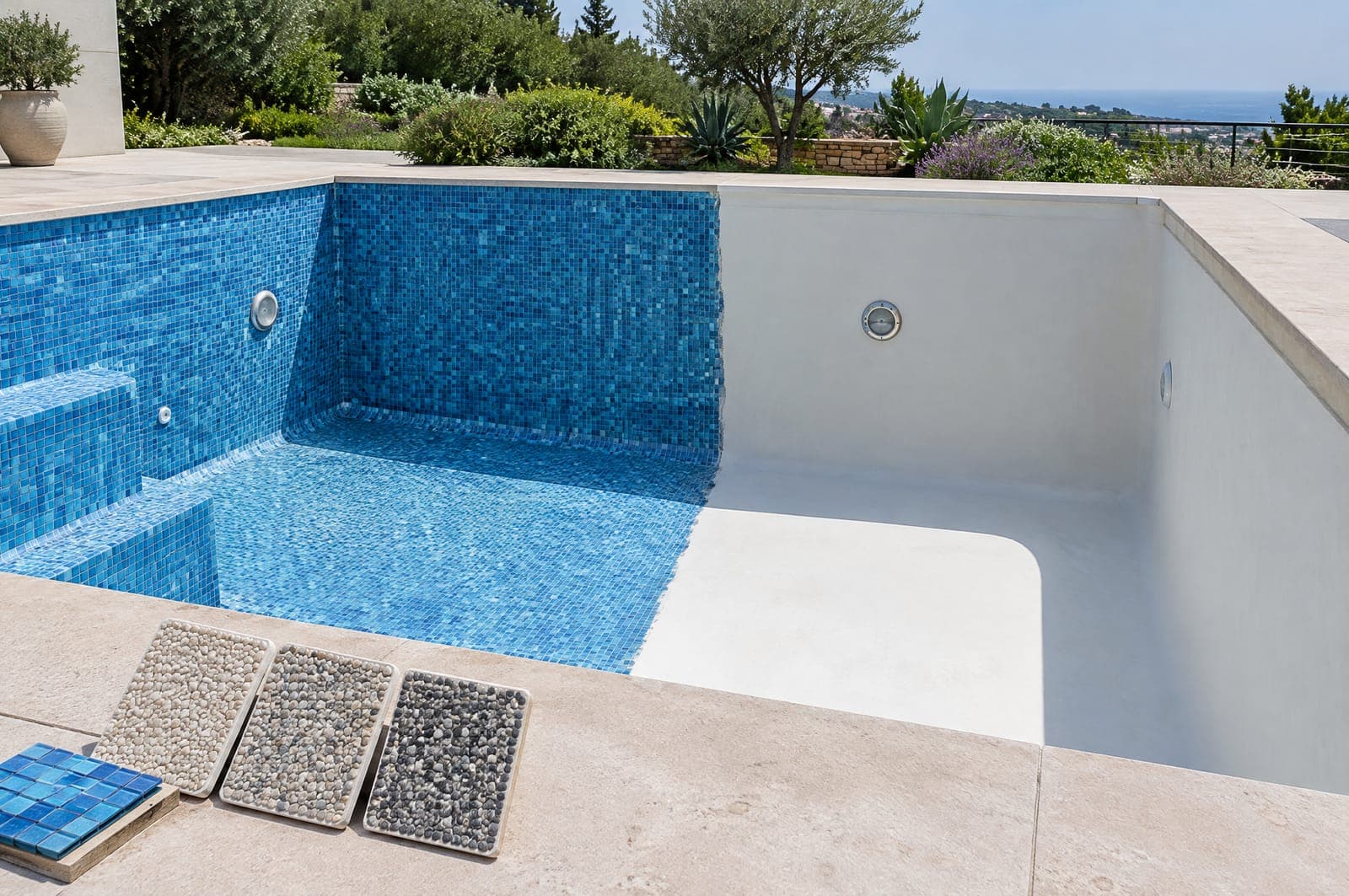
What is the best finish to resurface an old concrete pool?
Tiles, glass mosaic, cement-based plaster and pebble or quartz aggregate finishes all go onto a sound concrete shell, and none of them fixes a shell that leaks. Tiles and mosaic depend on a watertight, flat substrate and pool-rated adhesive and grout; plaster and pebble finishes depend on a careful 28-day start-up after filling. Choose the finish after the shell, waterproofing and water chemistry have been assessed.
What resurfacing covers
Resurfacing replaces the finish you see and touch on a concrete pool. The shell underneath stays as it is. If the concrete is cracked, if water is escaping, or if the old finish is falling away because the layer behind it has failed, a new surface on top will not last. A specialist should therefore look at the shell first, then the waterproofing, and only then talk about finishes. Our guide to cracked or loose pool tiles explains the warning signs.
The finishes most often discussed for concrete pools are ceramic or porcelain tiles, glass mosaic, cement-based plaster, and aggregate finishes such as pebble or quartz.
Tiles and glass mosaic
Tiles and mosaic are bonded to the shell with adhesive, and the joints are filled with grout. Manufacturers of tiling systems treat the substrate as the deciding factor.
Mapei's technical service writes that only watertight reinforced concrete pool shells are suitable for receiving tiles, and that the shell should pass a watertightness test before installation starts. Concrete pool walls are rarely flat enough for tiles, so the surfaces are levelled, then waterproofed with a flexible membrane before tiling. ARDEX UK quotes the British Standard tolerance it works to: deviations of no more than 3 mm under a 2 m straight edge.
The adhesive and grout matter as much as the tile:
- Adhesive. It has to be suitable for permanent immersion. Construction Chemicals, an Australian manufacturer, specifies flexible adhesives where tiles go over a membrane and restricts glass mosaic to particular adhesives. ARDEX stresses solid bed fixing with no voids beneath the tiles.
- Grout. ARDEX separates cement-based grouts, which suit submerged areas where the water is balanced, from epoxy or reaction resin grouts, which it recommends for moving water around the pool edge and for outdoor or salt water pools. Mapei also points to epoxy grouts for higher chemical resistance.
- Movement joints. Expansion joints in the walls and floor are sealed with a suitable sealant, not grouted over.
Tiles and mosaic give a hard, colourfast surface, but they are unforgiving of shortcuts. A tile is only as good as the bond and the membrane behind it.
Cement-based plaster
Plaster is a cement-based coat applied to the prepared shell. It produces a smooth, continuous surface with no grout lines.
What sets plaster apart is the start-up. The National Plasterers Council (NPC) procedure, as published by the finishes supplier NPT, explains that plaster starts to hydrate as soon as it is mixed and that most of the cement cures within the first 28 days. During that period the procedure calls for:
- Filling the pool without interruption, with clean water, to avoid a ring mark.
- Testing and adjusting pH, alkalinity and calcium hardness every day.
- Brushing the whole surface at least twice a day to remove plaster dust.
- Keeping wheeled cleaners out of the pool until after day 28.
- Holding back chlorine for the first 48 hours, keeping heaters off until the plaster dust has gone, and not adding salt for 28 days.
A plaster finish is only as good as that first month. If a maintenance contractor looks after your pool, agree in writing who carries out the start-up and keeps the record.
Pebble and other aggregate finishes
Aggregate finishes blend natural pebbles, quartz or glass beads into the finish coat. PebbleTec, which makes them, describes the result as a textured surface and says pebble finishes are generally more durable than traditional plaster because the exposed aggregate resists cracking, staining and fading. That is a manufacturer's claim, but it fits how the material works: the stones take the wear instead of the cement paste.
Texture is the trade-off. Larger pebbles feel rougher underfoot, and manufacturers offer smaller pebble and polished glass ranges for a smoother feel. Stand on a sample board, ideally wet, before choosing.
Aggregate finishes are cement-based, so the same start-up discipline applies.
How to choose
Once the shell has been assessed and found sound:
- Tiles or mosaic suit owners who want a crisp, colourfast surface and a contractor who will test, level, waterproof and use pool-rated adhesive and grout.
- Plaster suits a smooth, joint-free finish where someone can commit to the 28-day start-up.
- Pebble or quartz suits a harder-wearing cement finish with more texture, if you accept the feel underfoot.
- Salt chlorination changes the specification. Tell the contractor if the pool uses one: ARDEX recommends epoxy grout for salt water pools, and the NPC procedure delays salt after plastering.
What the quote should name
A good resurfacing quote states:
- how the existing finish will be removed and how the shell will be inspected
- whether a watertightness test is included before the new finish goes on
- the waterproofing product and the number of coats
- the adhesive, grout and sealant by product name, and whether they suit immersion and salt water
- who handles the start-up after filling, and for how long
A contractor who cannot put those points in writing is not ready to resurface your pool.
How this connects
- Problems and parts it covers
Questions people ask
Can new tiles go straight over old tiles?
Tiling system manufacturers expect a watertight, flat, sound substrate with a flexible membrane under the tiles. Over an old finish, nobody can confirm the shell, the membrane or the bond, so the safer approach is to remove the old finish and inspect the shell first.
Which grout should I use in a salt water pool?
ARDEX UK recommends epoxy or reaction resin grout for outdoor and salt water pools and for areas of moving water around the edge. Cement-based grouts suit submerged areas where the water is kept balanced.
How long before I can swim in a newly plastered pool?
The National Plasterers Council start-up runs for 28 days, with daily testing and twice-daily brushing, and it advises not swimming until the water is balanced and sanitised. Your contractor should tell you when the pool can be used and what to avoid during that period.
Sources
- Installing ceramic tiles in pools: application guidelines, Mapei (Realtà Mapei). Accessed 25 Oct 2026.
- The ARDEX Guide to Tiling in Swimming Pools, ARDEX UK. Accessed 25 Oct 2026.
- Waterproofing and Tiling Swimming Pools, Construction Chemicals. Accessed 25 Oct 2026.
- Swimming Pool Start-Up Procedures from National Plasters Council, NPT Pool Finishes (National Plasterers Council procedure). Accessed 25 Oct 2026.
- PebbleTec Pool Finishes, Pebble Technology International. Accessed 25 Oct 2026.
Next review due 24 Apr 2027
This guide explains general principles. It is not engineering advice and cannot tell you what is wrong with a specific pool. Rules change: check with the authority named in the sources before relying on them.