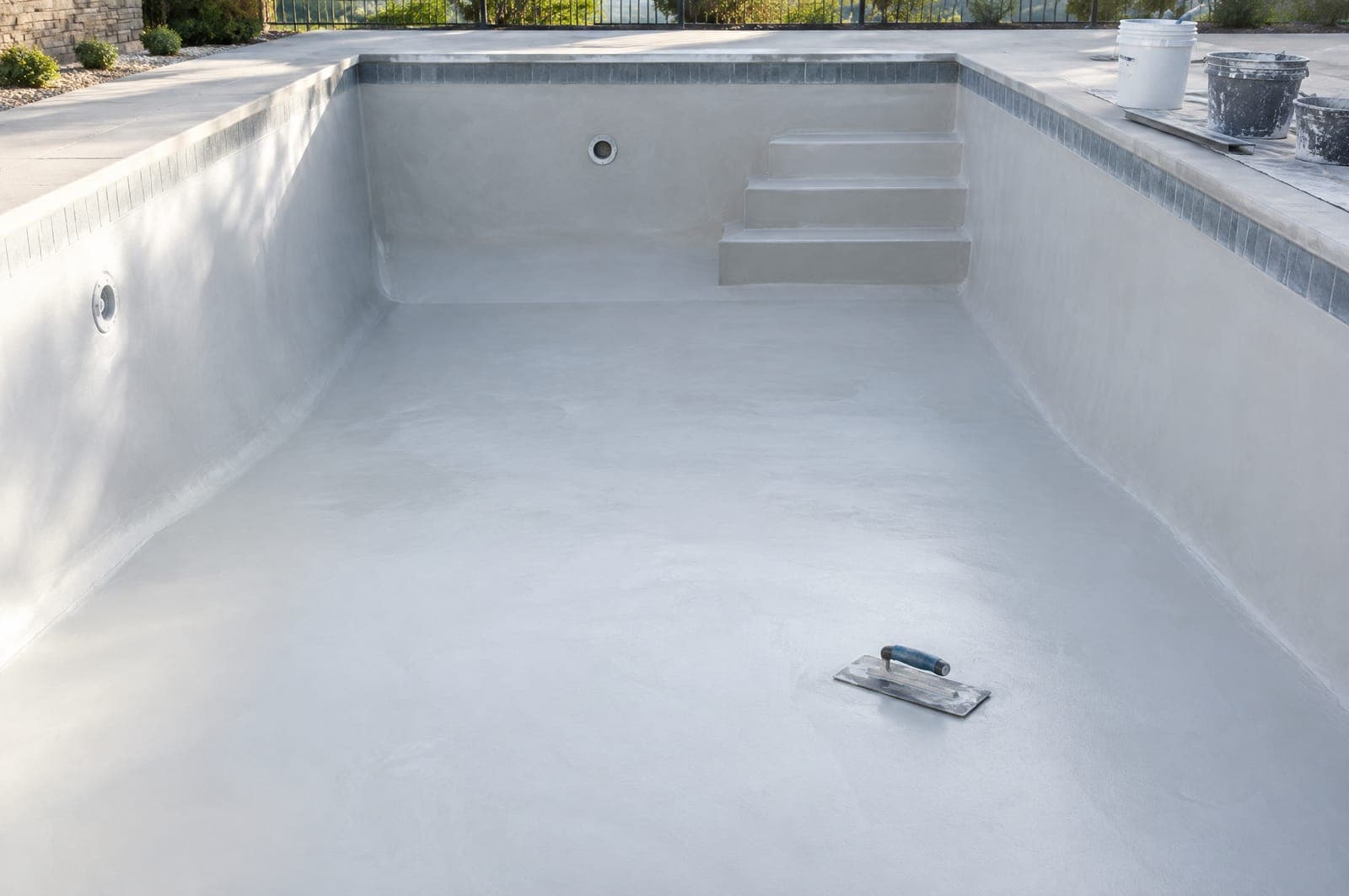
Resurfacing
Resurfacing puts a new interior finish, such as plaster, pebble, render or tile, over a structurally sound shell. Owners choose it when the old finish is rough, stained, etched or failing but the concrete beneath is still in good order.
When you need it
- The surface feels rough on feet or snags swimwear.
- Staining, etching, flaking or patches of missing finish.
- The colour has faded unevenly and cleaning no longer helps.
- As part of a renovation once old tiles or plaster have been removed and the shell repaired.
Resurfacing is not a leak repair. If the pool is losing water, have it checked first so the new finish does not need to be opened again later.
How a specialist does it
In general terms:
- Drain and inspect. The shell is checked for cracks, hollow areas and damage that must be repaired first.
- Prepare. The old finish is removed or roughened and cleaned so the new one bonds properly.
- Repair cracks, fittings and any waterproofing problems found during preparation.
- Apply the finish in the system the manufacturer specifies.
- Fill and start up. For plaster and similar cementitious finishes, this is the stage owners most often underestimate.
The start-up procedure of the National Plasterers Council, as published by NPT Pool Finishes, runs for 28 days after filling. During that time the water is tested and balanced regularly, the whole surface is brushed thoroughly at least twice a day to remove plaster dust, and wheeled cleaners and most automatic chemical feeders are kept out of the pool. NPT states that plaster starts hydrating as soon as it is mixed and that 86% of the cement in the plaster cures within the first 28 days. The procedure also says not to add chlorine for the first 48 hours and not to run a heater until the plaster dust is gone.
NPT notes that start-up is normally the responsibility of the remodelling company or builder, who must follow it to keep the finish warranty, and that owners should understand the process they are paying for.
Tile finishes follow a different path, with adhesive, grout, movement joints and cure times before filling. The tile and mosaic repair page covers that in more detail.
What to ask before you hire
- Which finish do you recommend for my pool, and why?
- What shell repairs do you expect before resurfacing?
- Who carries out the start-up, you or me? If me, will I get written instructions?
- Which manufacturer's warranty applies, and what conditions does it set?
- Can my automatic cleaner, salt system or chemical feeder run during start-up?
- When can the pool be used again, and is that in the programme?
UAE notes
High temperatures affect how cementitious finishes set and how fast water chemistry drifts during the first weeks. Ask the contractor how they schedule resurfacing in hot months and how they manage water temperature and dosing during start-up.
Fill water varies by source and building. The NPC procedure starts by adjusting alkalinity, pH and calcium hardness from the first day, so ask whether the fill water will be tested before start-up begins.
Dubai Municipality's plan approval guidelines require pool floors to be light coloured and smooth. If you are considering a dark or heavily textured finish, check with the specialist whether that affects your pool's approval.
For shared and hotel pools, the start-up period means the pool stays closed for longer than the application itself. Building managers should plan resident or guest notices around the full 28 days if a plaster finish is chosen.
Questions people ask
Why does a new plaster finish need brushing twice a day?
The NPC start-up procedure published by NPT calls for brushing at least twice daily to remove plaster dust while the new surface cures. It is part of protecting the finish and its warranty.
Is resurfacing the same as waterproofing?
No. Resurfacing renews the visible finish. Waterproofing is the membrane behind it that keeps water in the shell. A renovation may include both.
Will resurfacing stop my pool losing water?
Not reliably. Leaks are often in pipes, fittings or the shell behind the finish, so have the pool checked for leaks before resurfacing.
Sources
- Swimming Pool Start-Up Procedures from National Plasterers Council, NPT Pool Finishes. Accessed 25 Oct 2026.
- Technical Guidelines for Approval of Swimming Pool Plans (DM-HSD-GU34-ASPP2), version 4.0, Dubai Municipality, Health and Safety Department. Accessed 25 Oct 2026.
General information, not engineering advice. Only an inspection tells you what is wrong with a specific pool.
Specialists for resurfacing
All 19Alfenon Aljameela Swimming Pool Installation L.L.C.
Al Garhoud, Dubai
Unclaimed listing- Resurfacing (stated by public sources, unconfirmed)
Altaif Pool Cleaning
Al Murar, Dubai
Unclaimed listing- Resurfacing (stated by public sources, unconfirmed)
ArabCare
Al Barsha, Dubai
Unclaimed listing- Resurfacing (stated by public sources, unconfirmed)
Backyard Landscape LLC
Al Quoz, Dubai
Unclaimed listing- Resurfacing (stated by public sources, unconfirmed)
Burj Al Wasl
Dubai
Unclaimed listing- Resurfacing (stated by public sources, unconfirmed)
CESPRO Facility Management Services & Maintenance L.L.C.
Musaffah, Abu Dhabi
Unclaimed listing- Resurfacing (stated by public sources, unconfirmed)
- Unclaimed listing
- Resurfacing (stated by public sources, unconfirmed)
Dream Pool Dubai
Business Bay, Dubai
Unclaimed listing- Resurfacing (stated by public sources, unconfirmed)
Falak Almurjan
Al Quoz, Dubai
Unclaimed listing- Resurfacing (stated by public sources, unconfirmed)
Green Creation
Dubai
Unclaimed listing- Resurfacing (stated by public sources, unconfirmed)