Cracked or loose pool tiles and mosaic: causes and repair options
6 min read. Checked against the sources below on 24 Oct 2026 by the Dubai Pool Pros editorial team. Not engineering advice.
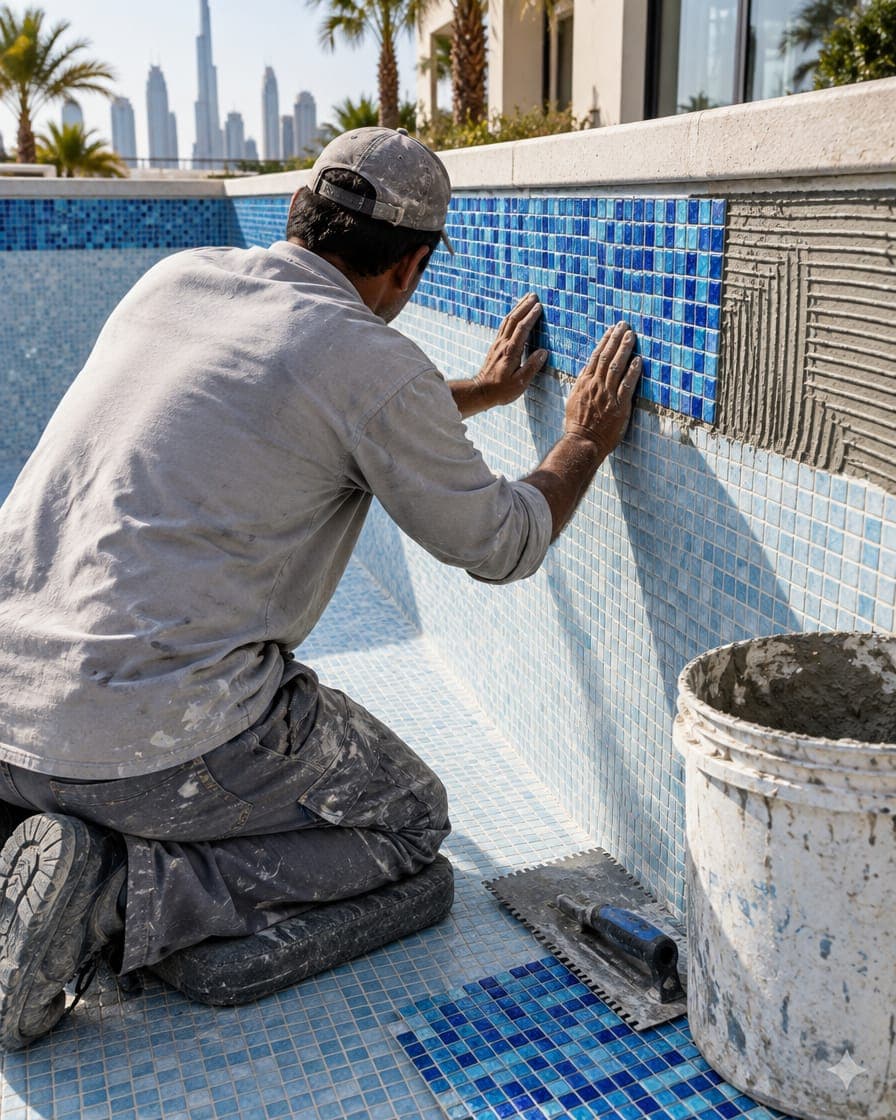
Why are my pool tiles cracking or falling off?
Pool tiles usually crack or come loose because of movement at joints that were tiled over, voids behind the tiles from incomplete adhesive coverage, products not suited to permanent immersion, or water chemistry attacking grout and adhesive. Isolated tiles can often be re-fixed, but widespread hollow tiles or tile failure combined with water loss can point to a problem in the shell or waterproofing that a specialist should investigate first.
What you might be seeing
Tile problems show up in a few recognisable ways:
- hairline cracks running across one or several tiles
- grout washing out of the joints or turning soft
- tiles that sound hollow when tapped
- single tiles, or whole mosaic sheets, lifting or missing, often at the waterline
- cracked or loose coping stones at the pool edge
Each has a different likely cause, which is why a photo of the pattern helps a specialist more than a description of one broken tile.
The common causes
Tiles fixed rigidly across a movement joint
The pool shell and the deck around it are usually different structures made of different materials, and they move differently. ARDEX explains in a technical bulletin that tiles bonded solidly across the junction between pool shell and surround span what is in effect a movement joint, and anything rigidly bonded across it will very likely crack. The tiling standard it cites calls for a movement joint that coincides with that junction.
The same bulletin warns about the alternative of bonding a coping tile to one side only. The overhanging edge is then unsupported and can break when swimmers lever on it to climb out, or when it is stood on.
Movement comes from several sources: heating and cooling of the materials, moisture in the ground, settlement of the deck and loads in the water. Under strong sun, coping and waterline tiles see the biggest daily swings, so cracks along the edge are often the first sign.
Voids behind the tiles
Full adhesive contact matters more in a pool than almost anywhere else. UltraTileFix states that full bed adhesion without voids is critical. In the ARDEX case study, failed tiles showed uncompressed notch lines from the trowel, with the voids full of water and the adhesive damaged by it.
A tile that sounds hollow when tapped usually has a void or a lost bond behind it. One hollow tile may be a local fault. Many hollow tiles across an area suggest a wider bond failure that will keep spreading.
Mosaic has its own trap. ARDEX notes that sheet mosaic must not be held on a backing glued with a water-softening adhesive, and that at least 85 percent of the back face of each tile needs to be available for adhesive contact. Another manufacturer, Construction Chemicals, limits the backing adhesive to no more than 10 percent of the back of the sheet.
The wrong product for permanent immersion
Pool tiles need an adhesive rated for continual immersion. UltraTileFix specifies a highly modified cementitious adhesive to EN 12004 that can withstand continual immersion, and suggests epoxy grout where aggressive cleaning chemicals are used. On fibreglass pools, ARDEX recommends tiling only at and just below the waterline, not at depth, and only after the gelcoat has been properly roughened.
Water chemistry
Construction Chemicals states that immersed tiling must be protected from pool chemicals and chemical balance problems, and that correct pH, alkalinity and calcium hardness must be maintained. Dubai Municipality's private pool guideline sets acceptable ranges for these values and asks owners to test calcium hardness, alkalinity, saturation index and cyanuric acid every 15 days. Soft, eroding grout is often a water balance question as much as a tiling one.
When tiles point to a waterproofing problem
Tiles and grout are a finish. UltraTileFix makes the point clearly: adhesives and grouts classified as water resistant retain their strength when immersed, but this does not mean they stop water passing through. The construction underneath has to be watertight in its own right.
A specialist will look beyond the tiles when:
- tile failure is widespread rather than local
- the pool is losing water and leak detection has ruled out the pipework
- damp patches, staining or salt deposits appear on walls next to the pool or below it
- tiles are being pushed off from behind
Groundwater is part of this picture. Construction Chemicals tells installers not to apply its waterproofing membrane on in-ground concrete pools subject to negative or hydrostatic water back pressure, because water pushing from behind the shell works against a membrane on the inside face.
Repair options
Depending on what the inspection finds, a specialist will usually propose one or more of:
- Re-fixing individual tiles where the cause is local and the surrounding bond is sound
- Regrouting, in cement-based or epoxy grout, after any water balance problem is corrected
- Forming proper movement joints with a flexible sealant at the shell and deck junction, and at corners and changes of plane
- Re-bedding coping so the stone is fully supported
- Stripping and re-tiling an area, often with a waterproofing membrane, where bond failure is widespread. At that scale the job becomes a renovation.
Most tile repairs need the water level lowered or the pool emptied, and the repaired area must cure before refilling. Curing times are set by the product system, not by the contractor's preference, and they differ: UltraTileFix advises at least three days before grouting and at least three weeks before water is introduced, while Construction Chemicals gives a minimum of seven days at 23°C and 50 percent relative humidity, longer in cooler conditions, before filling. Ask which system will be used and what its timings are.
Questions to ask a tiling specialist
- What do you think is causing the failure, and how did you check it?
- Which adhesive, grout and sealant will you use, and are they rated for immersion?
- Will you form movement joints where they are missing?
- How long must the repair cure before the pool is refilled?
- Does any of this suggest a waterproofing problem behind the tiles?
Until the repair is done, keep swimmers away from sharp broken tiles and loose coping. Dubai Municipality's guidelines ask owners and operators to repair or replace damaged parts of a pool immediately.
Questions people ask
Can a single loose pool tile be re-fixed without emptying the pool?
Sometimes the water can simply be lowered below the tile, but the adhesive still needs to cure before the area is submerged again. Ask the specialist which product they will use and what its curing time is before the pool can be refilled.
Why do tiles fail mostly at the waterline and on the coping?
These areas see the most movement: sun heats them, splashing wets and dries them, and swimmers lean on the edge. ARDEX also warns that coping bonded across the shell and deck junction, or left overhanging without support, is prone to cracking.
Are hollow-sounding tiles a problem if they are not loose yet?
They usually mean a void or lost bond behind the tile. A few may be a local fault, but many hollow tiles across an area suggest a wider bond failure, which is worth having assessed before tiles start coming off.
Sources
- Technical Bulletin TB198: Pool coping and water line tiling, fibreglass and concrete swimming pools, ARDEX Australia. Accessed 24 Oct 2026.
- Tiling swimming pools and permanently wet areas, UltraTileFix, Instarmac. Accessed 24 Oct 2026.
- Waterproofing and Tiling Swimming Pools, Construction Chemicals. Accessed 24 Oct 2026.
- Private Swimming Pools Safety Guidelines (DM-HSD-GU80-PRSPS2), Dubai Municipality, Health and Safety Department. Accessed 24 Oct 2026.
This guide explains general principles. It is not engineering advice and cannot tell you what is wrong with a specific pool. Rules change: check with the authority named in the sources before relying on them.