UAE specific
Pool safety for homes with children in the UAE: barriers, covers, alarms and supervision
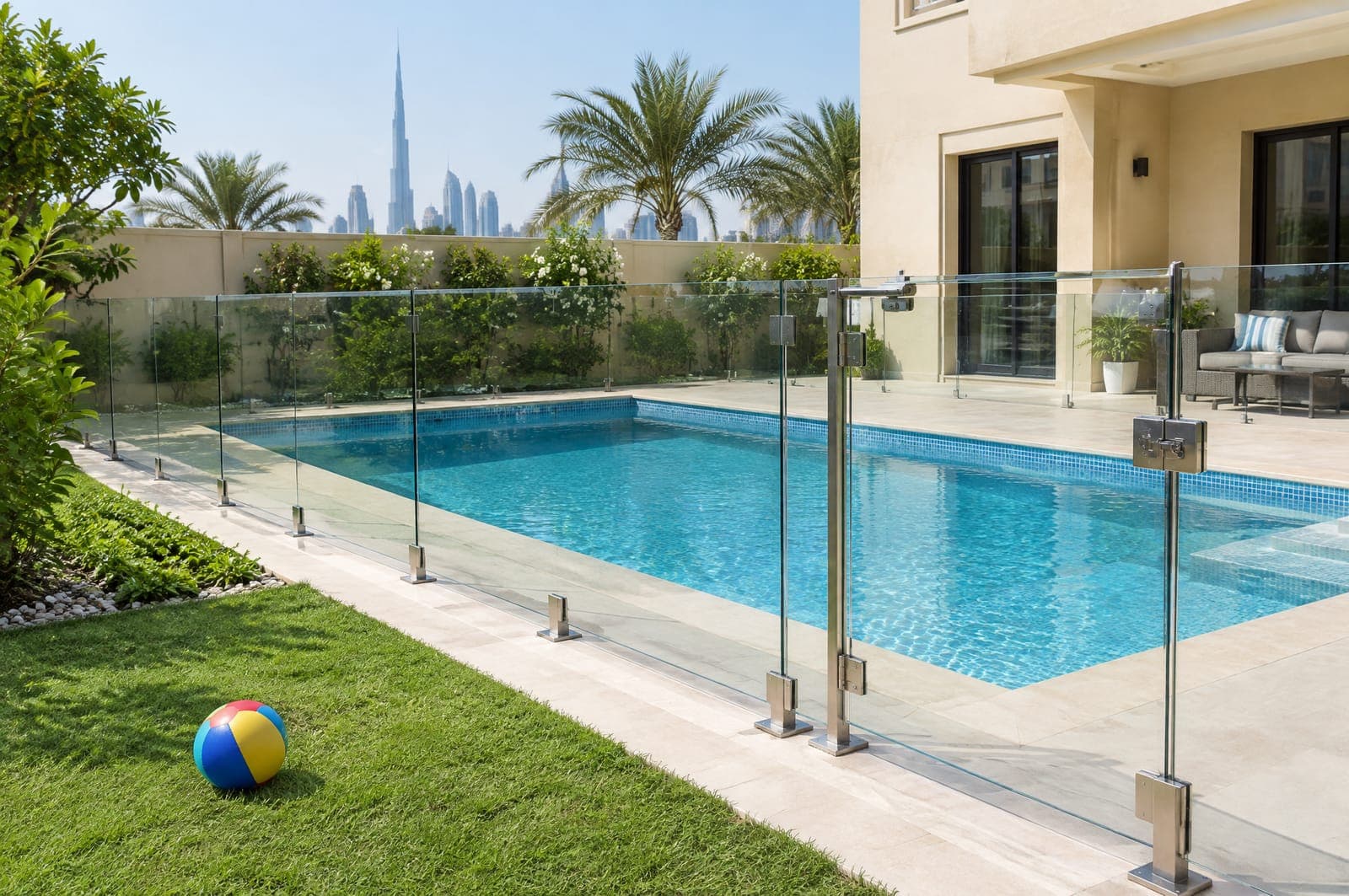
What safety measures does a villa pool need if there are young children at home?
In Dubai, the Dubai Municipality private pool guideline requires every private pool to have a permanent enclosure at least 1.20 m high with outward-opening, self-closing, self-latching gates, and recommends a safety cover or net as an extra layer. WHO, CDC and the US Consumer Product Safety Commission agree that fencing, constant adult supervision, swimming lessons and CPR skills work together. Covers and alarms add protection but replace none of these.
Why this matters
The World Health Organization's fact sheet on drowning says children under five account for nearly a quarter of drowning deaths worldwide, and that the risk increases when children are around water without active adult supervision. The CDC states that more children aged 1 to 4 die from drowning than from any other cause, and that drowning happens in seconds and is often silent. Dubai Municipality's guideline for private pools notes that its own accident investigations found most drowning incidents involved children and an absence of adult supervision.
Barriers buy time. Supervision closes the gap.
The barrier around the pool
Dubai Municipality's Private Swimming Pools Safety Guidelines (DM-HSD-GU80-PRSPS2) apply to private villa pools in Dubai, including spas, hot tubs and portable pools that can be filled to 300 mm or more. Every private pool must have an enclosure that restricts access, especially by children, and it must be permanent, meaning it cannot be removed without tools. The main requirements:
- Height. At least 1.20 m, measured on the side facing away from the pool.
- Gaps. No more than 100 mm under the fence on a hard surface (less on grass or gravel) and no more than 100 mm between vertical bars.
- Climbable objects. Furniture, planters, boxes and similar items at least 1.20 m from the enclosure on the outside and 300 mm on the inside.
- Gates. Opening outwards, away from the pool; self-closing and self-latching from any position; fitted with a lock; latch release at least 1.50 m above the ground.
- Doors. House doors may not be used as direct access to, or as part of the enclosure for, an outdoor pool.
- Windows and balconies. Windows opening onto the pool area need a fixed stop that limits the opening to less than 100 mm, or fixed screens or bars. Balconies over or near the enclosure need a balustrade that meets the enclosure rules.
The CDC gives similar advice: a four-sided fence at least four feet high that fully encloses the pool and separates it from the house, with self-closing, self-latching gates.
The guideline splits responsibilities. The owner is responsible for design, registration with Dubai Municipality and the safety equipment. The occupier, whether owner or tenant, keeps the enclosure and gate in working order and locked when the pool is not in use.
Covers and nets
Dubai Municipality recommends a safety cover or safety net as an additional layer. If one is fitted, it must cover the whole water surface and comply with ASTM F1346-91. It must hold 220 kg on pools wider than 2.4 m and 125 kg on smaller ones, drain standing water within five minutes after rain or sprinklers stop, and be secured by a locking or tensioning system a child cannot undo. It must be installed by the manufacturer or a competent person and removed completely before anyone swims.
The guideline defines a safety cover as one that keeps a child under five out of the water and supports the child off it. A light floating cover used to cut evaporation does not do that and should not be counted as a barrier.
Alarms
For indoor pools, where a house door may form part of the enclosure, Dubai Municipality requires that door to self-close, self-latch and lock, and to carry an alarm audible throughout the villa (at least 85 dBA measured 3 m away). The US Consumer Product Safety Commission's barrier guidelines advise that where the house forms one side of the barrier, all doors leading to the pool area should have door alarms.
Alarms tell an adult that something has happened. They do not stop a child reaching the water, so treat them as an addition to the fence.
Supervision and skills
Every source agrees on the human layer:
- Supervise closely and constantly. The CDC recommends a designated adult watching children in or near water, without distractions such as phones, reading or alcohol. Dubai Municipality requires competent adult supervision whenever the pool is in use, especially by children, people of determination or elderly people.
- Swimming lessons. The CDC says formal lessons can reduce the risk of drowning, and that children who have had lessons still need close and constant supervision. Dubai Municipality says the best way to safeguard children is to teach them to swim and supervise them.
- CPR and rescue equipment. The CDC recommends learning CPR. Dubai Municipality requires CPR signage and emergency numbers by the pool, a first aid box, and a pole or leaf scoop within reach to help someone in difficulty. The CPSC also recommends life-saving equipment such as a life ring or reaching pole.
- After swimming. The CDC advises shutting and locking doors that give access to water and removing toys that could draw children back to the pool.
Drains, chemicals and inspections
- Drain covers. The CPSC advises making sure any pool you use has anti-entrapment drain covers, and asking your pool service provider if you do not know.
- Chemicals. Dubai Municipality requires pool chemicals to be stored in a locked area, with keys or codes kept away from children.
- Inspections. The guideline asks occupiers to check safety devices and enclosures regularly, and owners to repair or replace damaged parts immediately.
A check you can do today
- Walk the enclosure and look for any point where a small child could get under, through or over it.
- Open the gate and let go from several positions. It should close and latch every time.
- Move chairs, planters and bins at least 1.20 m away from the outside of the fence.
- Confirm that no house door opens straight onto an outdoor pool area.
- Find the pole, the first aid box and the CPR sign.
- Agree who supervises, every time children swim.
If any part of the enclosure, gate or cover needs repair, have it fixed before the pool is used again.
How this connects
- Problems and parts it covers
- Chlorine feeder and dosing system
- Salt chlorinator
- Water test kit (source)
- I am not sure what is wrong
- Used to resolve
Questions people ask
Is a pool cover enough instead of a fence?
No. Dubai Municipality requires a permanent enclosure for every private pool and recommends a safety cover or net only as an additional layer. A cover protects only when it is in place and fastened.
How high must a pool fence be in Dubai?
Dubai Municipality's private pool guideline sets a minimum effective height of 1.20 m, measured on the side facing away from the pool, with strict limits on gaps and on climbable objects nearby.
Do pool alarms replace supervision?
No. Alarms alert an adult after a door opens or someone enters the water. WHO, CDC and Dubai Municipality all treat active adult supervision as essential whenever children are near the pool.
Sources
- Private Swimming Pools Safety Guidelines (DM-HSD-GU80-PRSPS2), Dubai Municipality, Health and Safety Department. Accessed 24 Oct 2026.
- Drowning (fact sheet), World Health Organization. Accessed 25 Oct 2026.
- Preventing Drowning, U.S. Centers for Disease Control and Prevention. Accessed 25 Oct 2026.
- Safety Barrier Guidelines for Residential Pools (Publication 362), U.S. Consumer Product Safety Commission. Accessed 25 Oct 2026.
Next review due 24 Apr 2027
This guide explains general principles. It is not engineering advice and cannot tell you what is wrong with a specific pool. Rules change: check with the authority named in the sources before relying on them.