Equipment
Salt water pools and chlorinators: how they work, common faults and effects on stone and metal
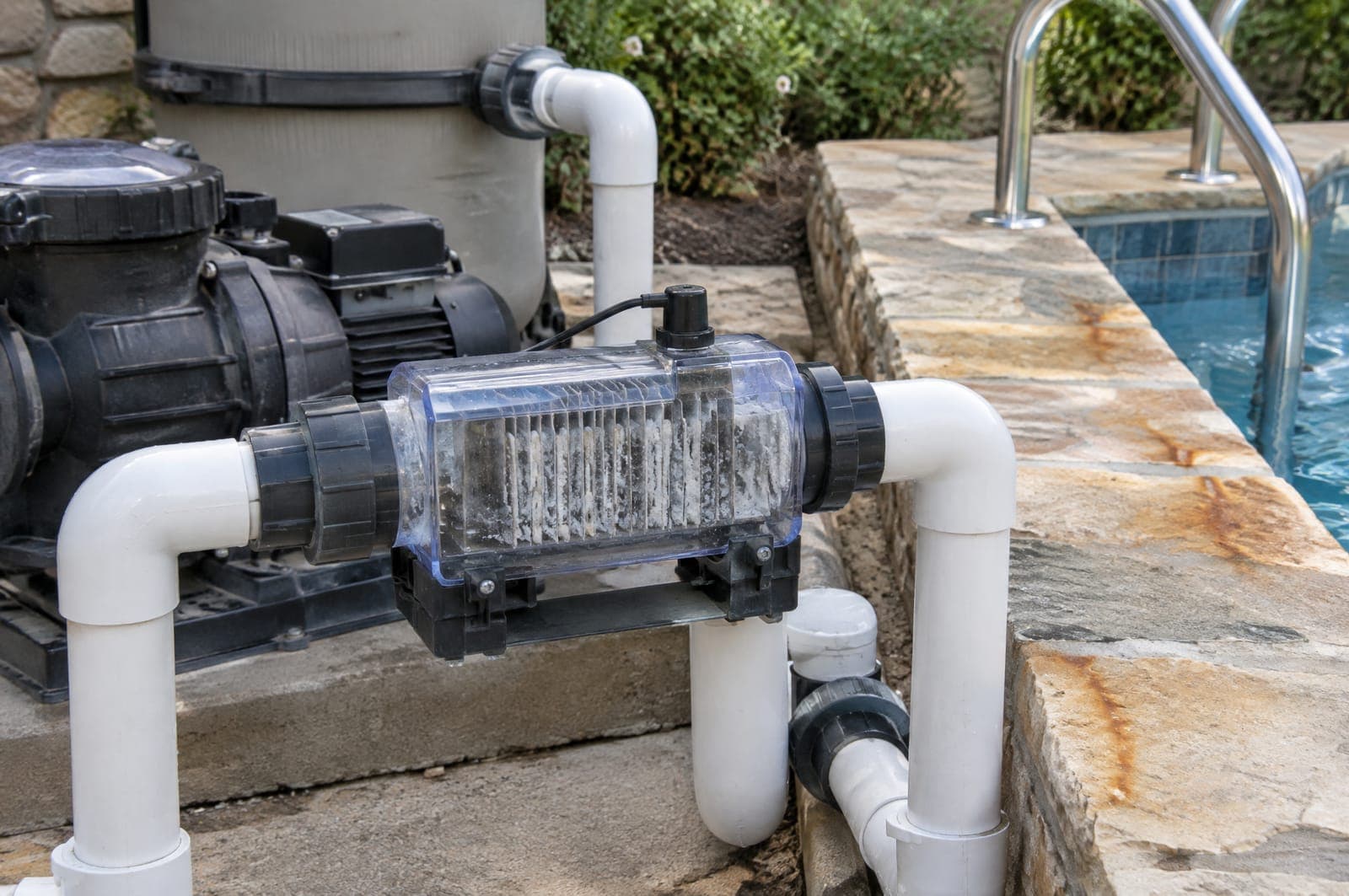
How does a salt chlorinator work, and does salt water damage stone and metal around the pool?
A salt chlorinator passes lightly salted pool water through an electrolytic cell that turns the salt into chlorine, which sanitises the water and then reverts to salt. Most faults come from a salt level outside the maker's range, scale on the cell plates or low flow. Manufacturers warn that salt raises the risk of corrosion of metal parts and certain natural and manmade surfaces, so stone, grout and fittings need to be chosen and protected with that in mind.
How a salt chlorinator works
A salt water pool is a chlorinated pool; the chlorine is made on site. Pentair's IntelliChlor user guide describes the process: a low concentration of salt is dissolved in the pool water, and the chlorinator cell uses electrolysis to produce chlorine, which dissolves at once into the sanitisers that kill bacteria and algae. These then revert to salt, and the cycle starts again.
Hayward's AquaRite manual adds that the salt level is low enough that it normally will not be tasted, and that salt is lost when water leaves the pool through backwashing, draining or splashing, not through evaporation. Topping up for evaporation therefore does not mean adding salt.
The chlorinator only produces chlorine. Pentair's guide says plainly that it does not monitor or control the chlorine level: the owner still has to test the water and adjust the output.
Salt level and water chemistry
Each chlorinator has its own operating range, so use the figures in your model's manual. Two examples:
- Pentair IntelliChlor: 3,600 ppm salt recommended; the unit turns off below 2,600 ppm; above 4,500 ppm may cause excessive corrosion of equipment and surrounding surfaces. Free chlorine above 4.0 ppm may cause corrosion of metal components.
- Hayward AquaRite: ideal salt of 2,700 to 3,400 ppm, with 3,200 ppm optimal; a warning light below 2,700 ppm; shutdown when salt is too low or too high.
In Dubai, the Dubai Municipality private pool guideline sets free chlorine of 1 to 2 mg per litre for private pools. Your maintenance company should keep the water within the authority's range and set the chlorinator output to match.
Three points from the manuals matter in the UAE:
- Avoid dry acid in arid climates. Pentair and Hayward both discourage sodium bisulfate (dry acid) for lowering pH where water evaporates heavily and is rarely diluted with fresh water, because by-products can build up and damage the cell.
- Scale points to calcium. Hayward says a build-up on the cell indicates an unusually high calcium level in the pool, often from old pool water.
- New plaster needs time. Pentair says not to run its chlorinator on newly surfaced plaster and to wait at least one month before adding salt; Hayward says 10 to 14 days. Follow the surface manufacturer's start-up guidance, which may be stricter.
Common faults
Scale on the cell plates. Hayward describes scale as light-coloured, crusty or flaky deposits. Its manual says to try flushing with a garden hose first, then scraping with a plastic or wooden tool (never metal, which scratches the plate coating), and to use a mild acid wash only in severe cases. Keeping the water chemistry in range is the simplest prevention. Many cells have a self-cleaning cycle; Pentair notes that this tends to shorten cell life and should be used only as much as necessary.
Low or no chlorine output. The usual causes listed in the manuals are salt below the operating range, a scaled or dirty cell, low flow from a dirty filter, a blocked basket, closed valves or a pump that has lost prime, and an output setting that is too low. Both makers fit a flow sensor that stops production when flow is inadequate.
Misleading salt readings. Pentair notes that readings vary between test strips, electronic testers and titration, and that its own sensor reads within plus or minus 500 ppm. Hayward advises having the salt level checked professionally before adding large quantities.
Inspection. Hayward recommends opening and inspecting the cell every three months or after cleaning the filter, and its control reminds you after about 500 hours of operation. Pentair suggests inspecting every two months at first and at least twice a year once the cell has stayed clean.
Leave electrical faults and cell replacement to a specialist. The control unit, cell and bonding of nearby metalwork are part of the pool's electrical installation.
Natural stone around a salt pool
Pentair's guide carries a warning that applies to every salt pool: salt is inherently corrosive, and metal parts and certain natural and manmade surfaces are particularly susceptible to corrosion and deterioration in and around salt water pools. Hayward's manual says a qualified stone specialist should be consulted on the type, installation, sealing and maintenance of natural stone coping or paving before a salt system is installed.
LITOSonline, a natural stone publication, explains the mechanism. It describes three forms of salt damage: efflorescence, where salt is left on the surface as water evaporates; cracking and flaking, where salt crystals form just below the surface and expand; and weakening, where water dissolves material inside the stone. Water reaches the stone from the pool, from rain and from below, through the bedding. Its recommendations:
- seal porous stone with a penetrating, breathable sealer (it favours modified silane products)
- treat all six faces of each stone where possible, especially the coping
- rinse the stone regularly with clean water, paying attention to the band just above the water line
On the tiles themselves, ARDEX UK recommends epoxy or reaction resin grout rather than cement grout for salt water pools.
Metal fittings
Ladders, handrails, light rims, fixings and grates are exposed to the same salt. The Australian Stainless Steel Development Association (ASSDA), writing about coastal environments, recommends grade 316 stainless steel, or a grade with equivalent corrosion resistance, as a minimum near the sea, together with regular washing to remove salt deposits. It warns against abrasive cleaners and cleaners containing chlorides or bleach, and says hydrochloric acid must not be used on stainless steel. Pool acid is hydrochloric acid, so keep splashes off fittings. ASSDA describes the brown "tea staining" that appears on stainless steel as a cosmetic form of corrosion that does not affect its structural integrity.
Before converting an existing pool to salt, list the stone and metal fittings with the specialist. Some may need sealing or replacing first.
How this connects
- Problems and parts it covers
- Chlorine feeder and dosing system
- Salt chlorinator
- Water test kit (source)
- I am not sure what is wrong
- Used to resolve
Questions people ask
Does a salt water pool still contain chlorine?
Yes. A salt chlorinator turns dissolved salt into chlorine by electrolysis, and the chlorine sanitises the water before reverting to salt. Pentair notes that the owner still has to test and adjust the free chlorine level.
Why does my chlorinator keep showing a low salt warning?
Salt is lost through backwashing, draining and splashing, and readings vary between test methods. Pentair's sensor reads within plus or minus 500 ppm, so have the salt level confirmed with a reliable test before adding more.
Will salt water damage my marble or limestone coping?
Pentair warns that certain natural surfaces are particularly susceptible to deterioration around salt pools, and Hayward advises consulting a stone specialist before installing a salt system. Penetrating, breathable sealers and regular rinsing reduce salt damage.
Sources
- IntelliChlor Salt Chlorine Generator Installation and User's Guide (IC15, IC20, IC40, IC60), Pentair. Accessed 25 Oct 2026.
- AquaRite 900 Series Electronic Chlorine Generator Owner's Manual, Hayward Pool Products. Accessed 25 Oct 2026.
- Treatment of natural stone in saltwater pools, LITOSonline. Accessed 25 Oct 2026.
- FAQ 6: Preventing Coastal Corrosion (Tea Staining), Australian Stainless Steel Development Association (ASSDA). Accessed 25 Oct 2026.
- The ARDEX Guide to Tiling in Swimming Pools, ARDEX UK. Accessed 25 Oct 2026.
Next review due 24 Apr 2027
This guide explains general principles. It is not engineering advice and cannot tell you what is wrong with a specific pool. Rules change: check with the authority named in the sources before relying on them.