Equipment
Pool chillers in the UAE: why summer water gets too warm and what a specialist checks
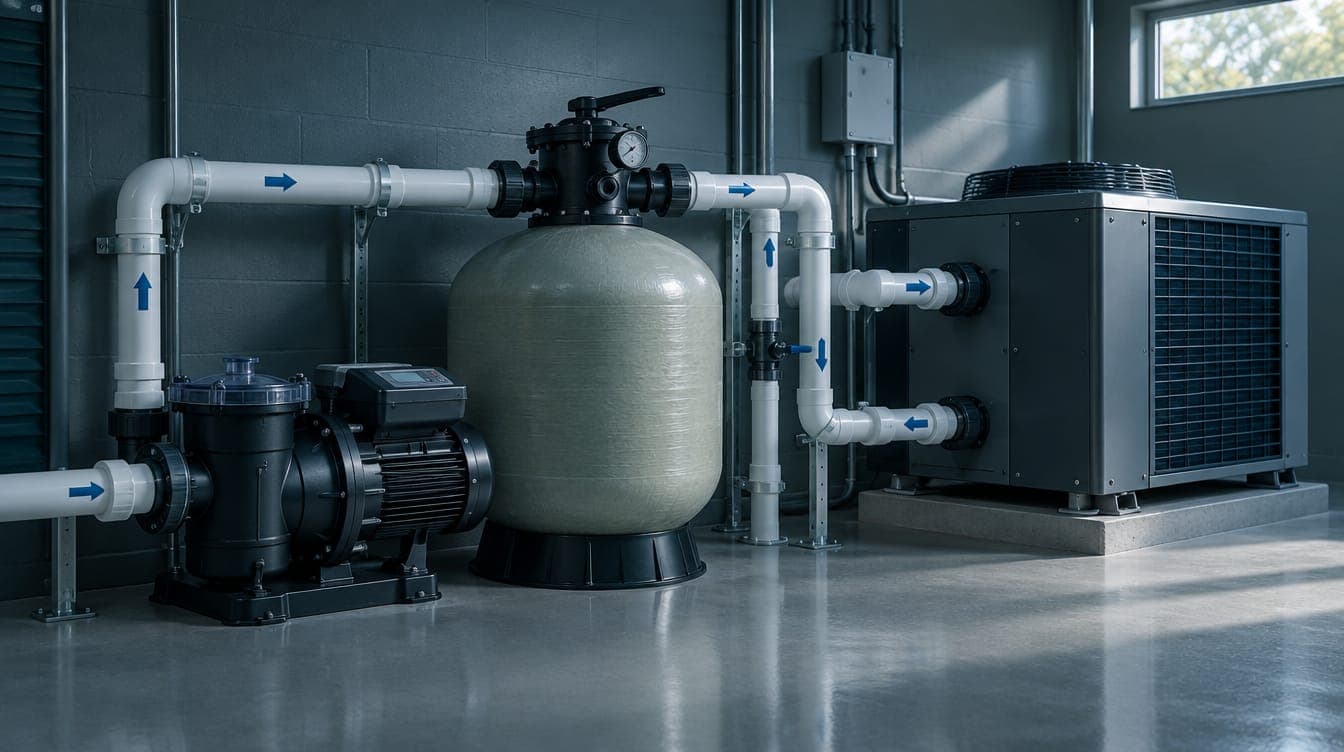
Why is my pool water so hot in summer and does a pool chiller work?
In a UAE summer the sun and the air keep adding heat to the water, so an unshaded pool can become uncomfortably warm. A pool chiller (or a heat pump with a cooling mode) uses a refrigeration cycle to move heat out of the water, and how well it works depends on correct sizing, adequate water flow, free airflow around the unit and the outdoor conditions.
Why summer water gets too warm
A pool is a large body of water sitting in the sun. During the UAE summer, direct sunshine and hot air add heat to it day after day, and the water has little chance to shed that heat. Evaporation removes some, but in the hottest months it is rarely enough to keep an exposed pool comfortable.
Warm water is also a water quality matter. Dubai Municipality's public pool guideline sets higher minimum free chlorine levels for pool water above 26°C than for water at 26°C. Warmer water asks more of the disinfection system, which is one more reason operators of shared and hotel pools pay attention to temperature.
How a pool chiller works in principle
Most pool chillers sold for residential and light commercial use are heat pumps. AstralPool describes the basic cycle used for heating:
- A fan draws outside air over an evaporator coil containing refrigerant, which absorbs heat.
- The refrigerant gas is compressed, which raises its temperature.
- The hot gas passes through a titanium heat exchanger and gives its heat to the pool water.
- The refrigerant returns to the start and the cycle repeats.
A chiller runs this the other way. In the Jandy VersaTemp manual, units with the optional chiller have a reversing valve that reverses the flow of refrigerant, transferring cold gas to the water and lowering its temperature. The heat taken out of the water is released to the air around the unit.
Manufacturers sell both heat and cool units and units built mainly for cooling. Hayward, for example, describes a range that can chill, cool and heat a pool with one device, with the cooling feature intended to bring the temperature down in hot summer months. Not every heat pump can cool, so check the model before assuming yours can.
What affects performance
The Jandy manual states that the output and efficiency of a heat pump depend on its components and, equally, on environmental conditions: air temperature, humidity, water temperature and wind. In practice, four installation factors decide whether a chiller keeps up.
- Water flow. Each unit has a minimum and maximum flow rate. Too little flow and the unit may trip on pressure faults or stop with a no-flow warning. Too much and a bypass valve is needed. A dirty filter or full baskets reduce flow.
- Airflow. The fan moves a large volume of air. The manual tells owners to keep objects off the top of the unit and to keep the air intake and discharge clear of debris, and it specifies minimum clearances around the unit.
- Condensation. The coil produces condensate, and the manual notes that the amount increases as outdoor humidity rises. The unit needs a base that drains, and condensate must not puddle.
- Plumbing order. Where a chiller shares the system with a heater or solar, all heat sources must be plumbed in series to work correctly.
Sizing questions to ask
A chiller that is too small will run for long periods without reaching the set temperature. A specialist should size the unit for your pool, not from a catalogue table alone. Ask them to explain how they have accounted for:
- Water volume and surface area, including the balance tank and pipework on an overflow pool
- Exposure: full sun or shade, rooftop or ground level, wind
- Your target temperature, and how quickly you expect the pool to reach it after start-up
- Flow: whether your existing pump delivers a flow within the chiller's minimum and maximum range, or whether a bypass or pump change is needed
- Electrical supply: manufacturers state the minimum circuit capacity and the maximum breaker size for each model
- Location: whether there is space for the required clearances and free airflow, where the condensate will drain, and how close the unit will be to bedrooms or neighbours
- Controls: whether the unit will be run from your existing automation system
At start-up, the Jandy manual recommends running the filter pump for longer so the heat pump has time to cool the water, then returning to normal operating times once the target is reached.
What a specialist checks on a chiller that is not keeping up
When an existing unit runs but the water stays warm, a service visit usually covers:
- the operating mode and set point on the controller
- water flow, the flow or pressure switch, and the condition of the filter and baskets
- the evaporator coil, cleaned if it is blocked, and the fan
- the condensate drain, cleared of debris
- fault codes such as high or low refrigerant pressure faults
- the refrigerant circuit, which should only be worked on by trained personnel; the Jandy manual specifies maintenance by a technician certified in heat pump repair where local requirements exist
- whether the unit is simply undersized for the pool and its exposure
Before you buy or replace
Ask for the sizing assumptions in writing, the exact model with its flow and electrical requirements, where it will be placed, and who will service the refrigerant circuit. If your pool is shared, cooling equipment and its location will usually need building management approval before installation.
How this connects
- Problems and parts it covers
- Pool heat pump (source)
- Pool equipment needs replacing
- Check valve (source)
- Chiller or heat pump
- The water is too warm in summer
- Pool chiller (source)
- Used to diagnose
Questions people ask
Can my pool heat pump also cool the water?
Only if it is a heat and cool model with a reversing valve or a dedicated cooling mode. Many heat pumps are heat only, so check the model number and the manual before relying on it for cooling.
Water is dripping under my pool chiller. Is it leaking?
Usually it is condensation from the coil, and the Jandy manual notes that condensation increases as outdoor humidity rises. If water keeps flowing for a long time after the unit has been switched off, ask a specialist to check for a water leak.
What temperature should a pool chiller be set to?
That is a comfort choice for the owner, and for shared pools a decision for the operator. Note that Dubai Municipality's public pool guideline sets higher minimum chlorine levels for water above 26°C, so warmer water needs closer attention to disinfection.
Sources
- VersaTemp JRT Series Heat Pump Installation and Operation Manual, Jandy (Fluidra), copy hosted by Clarkson Pools. Accessed 24 Oct 2026.
- How to Choose the Right Pool Heat Pump, AstralPool Australia (Fluidra). Accessed 24 Oct 2026.
- Hayward Launches HeatPro Heat+Chill Heat Pumps with Industry-First Microchannel Technology, Hayward Holdings. Accessed 24 Oct 2026.
- Public Swimming Pools Safety Guidelines (DM-HSD-GU81-PSPS2), version 3.0, Dubai Municipality, Health and Safety Department. Accessed 24 Oct 2026.
Next review due 24 Apr 2027
This guide explains general principles. It is not engineering advice and cannot tell you what is wrong with a specific pool. Rules change: check with the authority named in the sources before relying on them.