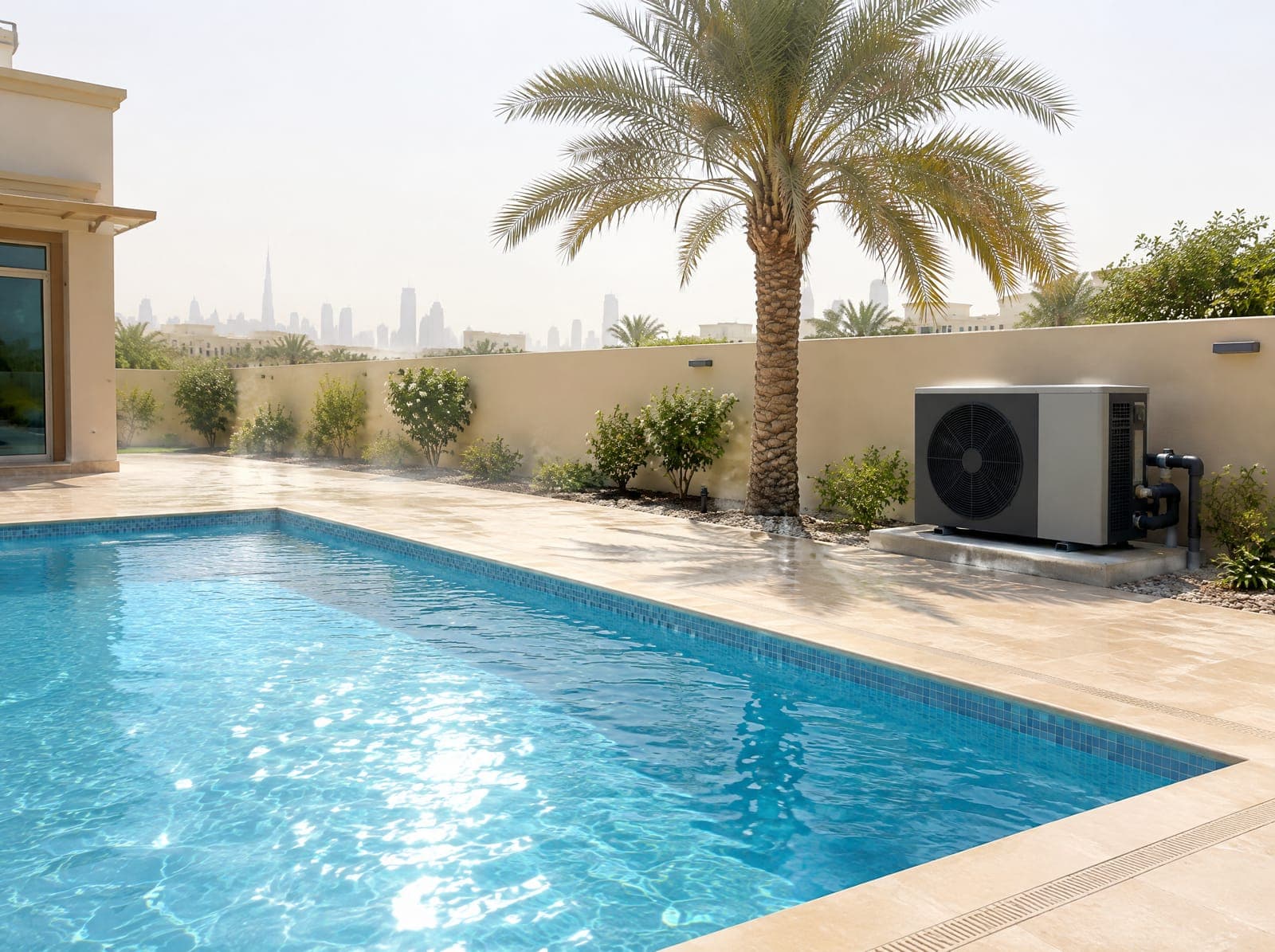
The water is too warm in summer
In a UAE summer an outdoor pool can become too warm to be refreshing, especially when it is shallow, in full sun or on a roof. A pool chiller, or a heat pump with a cooling mode, can bring the temperature down. This page explains what affects water temperature, what you can note yourself and what a chiller specialist will usually look at.
What you might notice
- The water feels warm rather than cooling from late spring onwards.
- An existing chiller runs for long hours without bringing the temperature down.
- The chiller shows an error code, cycles on and off or runs noisily.
- Water collecting under the chiller beyond the usual condensation.
- Algae or cloudy water appearing more quickly in hot weather.
Common causes
Warm water usually comes from the setting. Strong sun, high air temperatures, little shade, dark finishes and shallow water all add heat. Rooftop pools are exposed on all sides, and pipes running across a hot roof can warm the water further.
Where a chiller is installed but the water stays warm, common causes can include:
- A unit that is too small for the pool, or set to the wrong mode or set point.
- Restricted airflow. Jandy's installation and operation manual for its VersaTemp heat pumps asks owners to keep the air intake and discharge areas clear, keep plants trimmed away and make sure cooler discharge air is not drawn back into the intake.
- A unit placed in a tight enclosure where it draws in its own exhaust air.
- Low water flow through the unit, often linked to a dirty filter or a pump fault.
- Refrigerant or control faults that need a qualified technician.
Many current heat pumps can both heat and cool. Hayward, for example, describes its HeatPro range as able to cool a pool in hot months and heat it in cooler ones. Jandy's manual notes that in some situations a heat pump may run in chiller mode during the hottest part of the year and a heater during the cooler months.
What you can safely check yourself
- Log the temperature. Note the water temperature at the same time each day, with the air temperature if you can. Dubai Municipality's safety guidelines for private pools already ask for temperature, pH and chlorine to be tested daily before use.
- Look around the unit. Note whether leaves, boxes or plants block the air grilles. Moving loose items away is fine. Do not open its panels.
- Watch the condensation. Chillers produce water from their coil, and more in humid weather. Jandy's manual gives 3 to 5 gallons (about 11 to 19 litres) per hour as normal for its units, and says water that keeps draining from the base after the unit has been off for more than an hour can mean an internal leak.
- Note error codes. Photograph the display and the unit's rating plate.
What a specialist will usually do
A chiller specialist will usually check the size of the unit against the pool volume and the site, the airflow around it, the water flow through it and the controls. For a new installation they will look at where the unit can sit with enough clearance, how it connects to the existing pipework and whether the electrical supply is suitable. Jandy's manual states that its units are for outdoor use only and that the specified clearances must be kept.
Refrigerant work is specialised. Jandy's manual states that maintenance must be carried out by a technician certified in heat pump repair where local rules require it, and that the technician must comply with the regulations on handling the refrigerant. The same manual calls for an inspection at least once a year by a qualified technician.
What to prepare before you call
- The pool size and depth, and whether it sits in sun, shade or on a roof.
- Your temperature log.
- Make, model and capacity of any existing chiller or heat pump.
- Photos of where the unit sits and the space around it.
- The temperature you would like, and when you use the pool most.
- For buildings and hotels, whether plant space and the electrical supply can take a new unit.
Questions people ask
Can a heat pump cool a pool?
Many current models can heat and cool. Check your unit's manual or ask a specialist whether it has a cooling or chiller mode before buying a separate unit.
Is water dripping from my chiller a problem?
Some water is normal, because the coil produces condensation and more forms in humid weather. Water that keeps draining long after the unit has stopped can point to an internal leak, so mention it to a technician.
Where should a chiller be installed?
Outdoors, with the clearances the manufacturer specifies on every side and above, on a level pad, and where its discharge air is not drawn back in. A specialist will check your space against the manual for the model you choose.
Sources
- VersaTemp JRT Series Heat Pump Installation and Operation Manual, Jandy (Zodiac Pool Systems). Accessed 25 Oct 2026.
- Hayward Launches HeatPro HeatChill Heat Pumps with Industry-First Microchannel Technology, Hayward Holdings. Accessed 25 Oct 2026.
- Private Swimming Pools Safety Guidelines (DM-HSD-GU80-PRSPS2), Dubai Municipality. Accessed 25 Oct 2026.
General information, not engineering advice. Only an inspection tells you what is wrong with a specific pool.
Specialists who deal with this
All 22Al Qamar Pools
Ras Al Khaimah
Unclaimed listing- Pool chiller service (stated by public sources, unconfirmed)
- Equipment upgrades (stated by public sources, unconfirmed)
- Automation and controls (stated by public sources, unconfirmed)
Castle Innovative Swimming Pools L.L.C.
Deira, Dubai
Unclaimed listing- Pool chiller service (stated by public sources, unconfirmed)
- Equipment upgrades (stated by public sources, unconfirmed)
Falak Almurjan
Al Quoz, Dubai
Unclaimed listing- Pool chiller service (stated by public sources, unconfirmed)
- Automation and controls (stated by public sources, unconfirmed)
- Unclaimed listing
- Pool chiller service (stated by public sources, unconfirmed)
- Automation and controls (stated by public sources, unconfirmed)
Poolfix UAE
Dubai
Unclaimed listing- Pool chiller service (stated by public sources, unconfirmed)
- Automation and controls (stated by public sources, unconfirmed)
- Unclaimed listing
- Pool chiller service (stated by public sources, unconfirmed)
- Automation and controls (stated by public sources, unconfirmed)
Aquify
Abu Hail, Dubai
Unclaimed listing- Pool chiller service (stated by public sources, unconfirmed)
Pool Masters
Al Quoz, Dubai
Unclaimed listing- Pool chiller service (stated by public sources, unconfirmed)
Alfenon Aljameela Swimming Pool Installation L.L.C.
Al Garhoud, Dubai
Unclaimed listing- Pool chiller service (stated by public sources, unconfirmed)
- Unclaimed listing
- Pool chiller service (stated by public sources, unconfirmed)