UAE specific
Sandstorms, dust and summer heat: what they do to pool water, filters and equipment
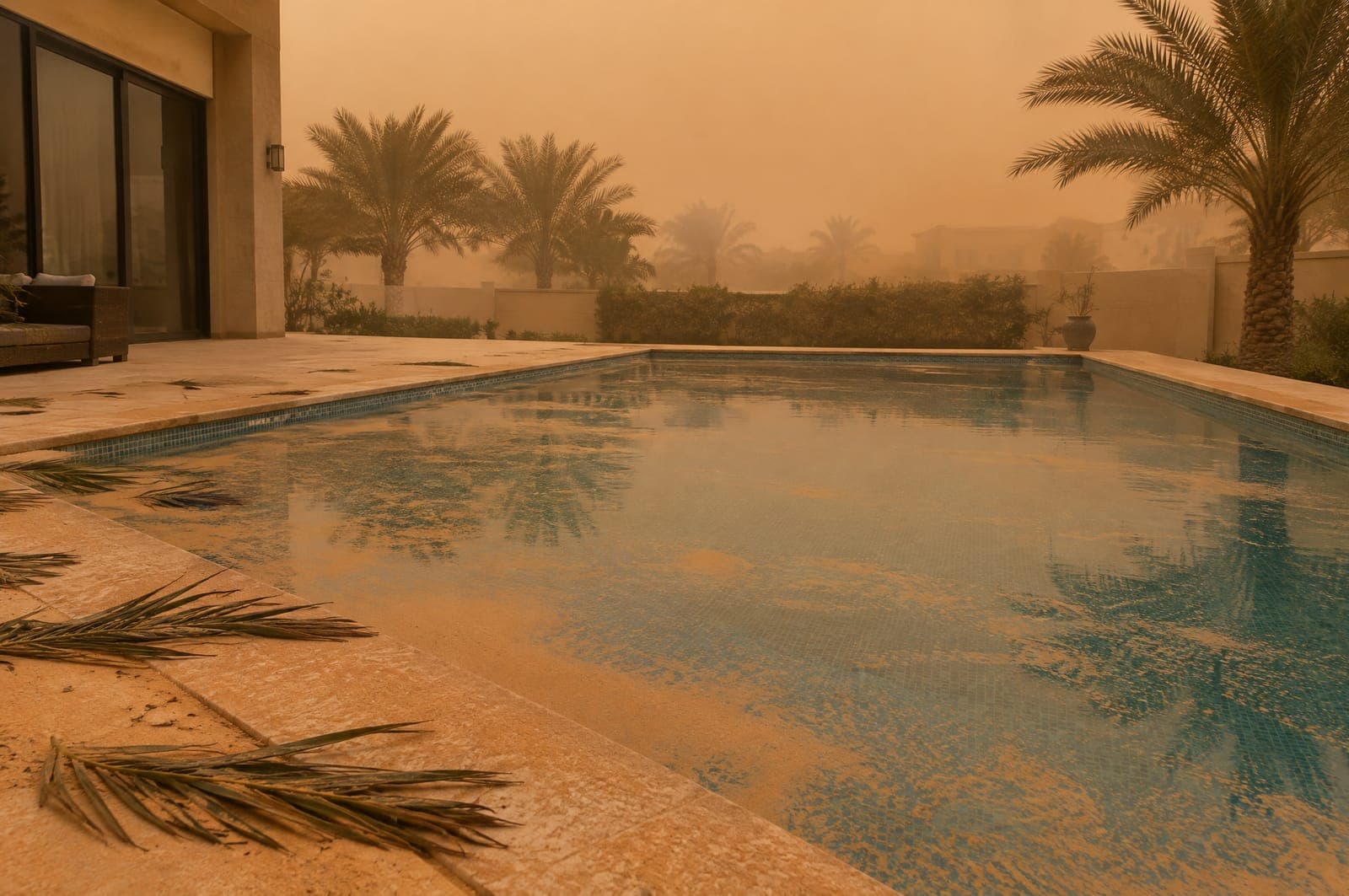
What should I do with my pool after a sandstorm?
Clear the surface and baskets, vacuum the settled dust, check the filter pressure and clean or backwash the filter as the manufacturer recommends, then test and adjust the water. Strong sun breaks down chlorine quickly in outdoor pools, and pumps need shade and airflow, so summer calls for more frequent testing and a closer eye on the plant room.
The conditions pools deal with
The Government of Dubai Media Office describes Dubai's summers as extremely hot and humid, with an average high of around 41.8 °C and overnight lows of around 29.7 °C, and notes that most days are sunny all year. Northerly and north westerly winds blow for much of the year. Add sand and dust storms, which the National Emergency Crisis and Disasters Management Authority (NCEMA) addresses in its public safety advice, and an outdoor pool in the UAE faces three loads at once: dust in the water, intense sunlight on the chlorine, and heat on the equipment.
Before a storm
NCEMA advises securing loose items and garden tools before a sand storm so the wind cannot carry them. Around a pool that means:
- stowing loungers, umbrellas and cushions, or tying them down
- fitting a safety cover if you have one and it is designed for the conditions
- making sure skimmer lids and baskets are in place
Dust in the water
Dust and sand that land on a pool either float, stay suspended or sink. The US Department of Energy's guide on pool pumps explains that filters only capture what is suspended in the water passing through them. Floating matter can be skimmed off, but once particles sink to the floor they stay there until they are vacuumed or brushed back into circulation. Skimmers deal with the surface. The floor needs a vacuum.
After a dust event:
- Empty the skimmer baskets and the pump strainer basket.
- Skim the surface.
- Brush the walls and steps, then vacuum the floor.
- Check the filter pressure gauge.
Filters take the hit
A filter's pressure rises as it collects dirt. Pentair's cartridge filter manual says to clean the filter when the gauge reads 8 to 10 psi above the original clean starting pressure, and notes that the rate of rise varies with bathing load, temperature and weather. The same manual says cartridge life varies with bather load, wind and dust. After a storm, expect the pressure to climb faster than usual and plan for an extra clean or backwash.
Write down your filter's clean starting pressure and keep it near the gauge. Without that number, a gauge reading means little.
If the pressure stays high straight after cleaning or backwashing, the filter media may be clogged or worn, or there may be a restriction elsewhere. That is the point to call a specialist.
Sun and chlorine
Strong sunlight destroys chlorine. NSW Health in Australia explains that ultraviolet light breaks down hypochlorous acid, the most effective form of free chlorine, and says outdoor pools can lose about 35 percent of their free chlorine for each hour of UV exposure. Cyanuric acid (stabiliser) bonds loosely to chlorine and greatly reduces that loss.
Stabiliser has limits. NSW Health reports little extra benefit above about 40 mg/L, sets a maximum of 50 mg/L for pools in its state, and warns that high levels reduce chlorine's ability to disinfect. Because stabiliser is only removed by splashing and backwashing, it builds up when stabilised chlorine products are used continuously. Local authorities in the UAE set their own acceptable ranges, so follow the local figures and have stabiliser tested regularly.
The practical point is timing. In summer, chlorine can fall a long way between visits. Test more often, and dose in the evening if your technician recommends it.
Heat and the plant room
Pumps and motors suffer in the heat. The DOE pump guide advises protecting motors from heat with shade and good ventilation, keeping the fan cover and cooling fins free of obstructions, and keeping motors away from dirt, moisture and stored chemicals. In dusty conditions, cooling fins and vents clog faster, so a quick wipe and check after a storm is worthwhile.
Warning signs that need a specialist:
- the pump trips, stops or restarts on its own
- the motor is too hot to touch or smells of burning
- the pump runs but the flow is weak and the baskets are clean
- the filter pressure will not come down after cleaning
A simple routine for the hot, dusty months
- Check the water at least daily and record the readings.
- Empty baskets and skim more often after windy days.
- Clean or backwash the filter by pressure, not by calendar.
- Keep the plant room shaded, ventilated and clear of chemicals.
- Book a check of the pump, filter and any chiller before the hottest months.
When it stops being maintenance
Dust and heat are routine in the UAE, and most of their effects are handled by cleaning, filtering and testing. When the water stays cloudy despite correct chemistry, the filter pressure behaves oddly, or the pump struggles in the heat, the problem has moved from maintenance to equipment, and a pump and filter specialist is the right call.
How this connects
- Problems and parts it covers
- Chlorine feeder and dosing system
- Salt chlorinator
- Water test kit (source)
- I am not sure what is wrong
- Used to resolve
Questions people ask
Should I switch the pump off during a sandstorm?
None of the sources used for this guide sets a rule on this. What matters most is clearing the baskets and checking the filter pressure afterwards, because dust loads the filter quickly. Ask your technician what suits your system.
Why does my chlorine disappear so fast in summer?
Ultraviolet light breaks down free chlorine. NSW Health says outdoor pools can lose about 35 percent of their free chlorine per hour of UV exposure without stabiliser, which is why stabiliser and frequent testing matter in strong sun.
Can I add more stabiliser to stop chlorine loss?
Only up to a point. NSW Health reports little extra benefit above about 40 mg/L and warns that high levels reduce chlorine's ability to disinfect, so have stabiliser tested and keep it within the range your local authority sets.
Sources
- Geographic Location & Climate, Government of Dubai Media Office. Accessed 25 Oct 2026.
- Sand Storms (awareness message), National Emergency Crisis and Disasters Management Authority (NCEMA). Accessed 25 Oct 2026.
- Clean & Clear Plus Cartridge Filters Owner's Manual, Pentair (manual hosted by Inyo Pools). Accessed 24 Oct 2026.
- Stabiliser (cyanurate) use in outdoor swimming pools, NSW Health. Accessed 25 Oct 2026.
- Measure Guideline: Replacing Single-Speed Pool Pumps with Variable Speed Pumps for Energy Savings, US Department of Energy, Building America. Accessed 25 Oct 2026.
Next review due 24 Apr 2027
This guide explains general principles. It is not engineering advice and cannot tell you what is wrong with a specific pool. Rules change: check with the authority named in the sources before relying on them.