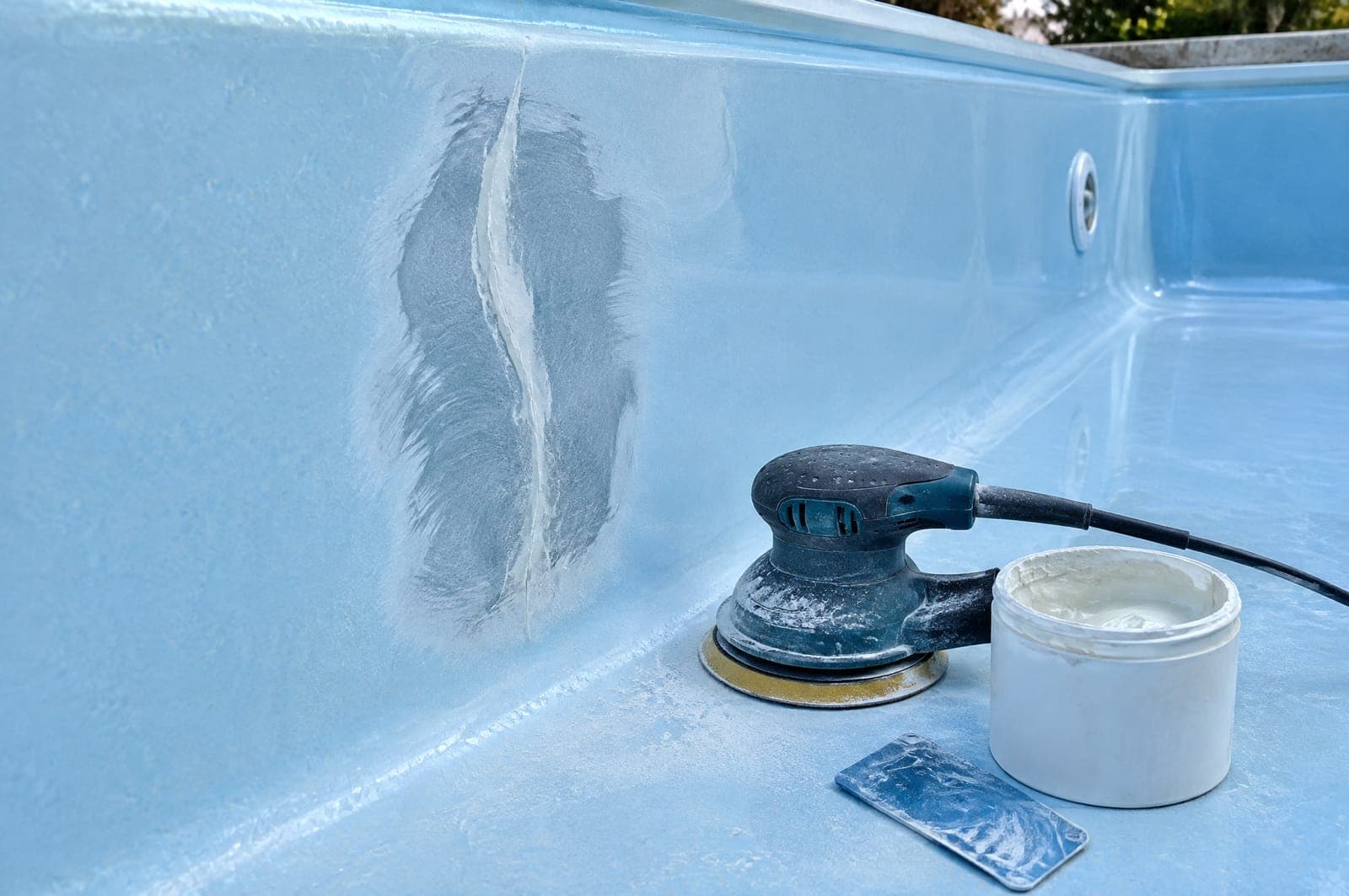
Fibreglass repair
Fibreglass repair covers gelcoat damage, osmotic blisters, cracks and edge problems on one-piece fibreglass pool shells. It calls for a specialist who understands composite materials and the particular risks of working on a fibreglass pool.
When you need it
- Small raised bubbles on the surface, often in patches.
- Hairline or star cracks in the gelcoat.
- Chalky, faded or discoloured areas.
- Cracked coping tiles or a separating joint along the pool edge.
- Bulging walls or floor, or a shell that appears to have moved.
River Pools, a fibreglass pool manufacturer, explains how osmotic blisters form. Water molecules pass through the gelcoat and reach the polyester resin behind it, where they combine with other particles into larger molecules that cannot pass back out. The result is raised blisters, usually small, which River Pools says do not go away and have no quick fix. Manufacturers use a vinyl ester resin barrier behind the gelcoat to reduce the risk.
How a specialist does it
- Assess the damage. The key question is whether the problem is cosmetic and limited to the gelcoat, or reaches the laminate and structure. Blisters, cracks and bulges point to different causes.
- Decide whether draining is needed. River Pools advises draining a fibreglass pool only when it is really necessary. The risks it lists are bulging walls and floors, splits in the floor and, in some conditions, the shell lifting. If draining is unavoidable, it recommends checking and removing groundwater around the shell or waiting for a drier period, bracing the pool, having a sump pipe to check and remove water, and getting professional help.
- Repair. Depending on what was found: grinding out and filling cracks and blisters, laminating where the structure is affected, and refinishing with a compatible gelcoat or coating.
- Edge detailing. ARDEX's bulletin on coping for fibreglass and concrete pools recommends a movement joint at the boundary between the shell and the surrounding slab. An alternative it describes is bonding the coping tile to the surround with a modified adhesive and to the fibreglass rim with a flexible sealant. Anything bonded rigidly across that joint tends to crack.
- Refill and balance the water carefully, following the coating maker's instructions.
What to ask before you hire
- Is the damage cosmetic or structural, and how did you decide?
- Does the repair need the pool drained? If so, how will you manage groundwater and bracing?
- Which resins, gelcoats or coatings will you use, and are they made for immersed pool use?
- Will the repaired area match the existing colour, or will you refinish a whole section?
- If the coping is cracking, will you put in a flexible joint at the shell edge?
- What warranty do you give, and does the original manufacturer's warranty still apply?
UAE notes
Ask directly how many fibreglass pool repairs a company has done. Experience with tiled concrete pools does not transfer automatically to composites, and not every pool company works on fibreglass.
Sun exposure is strong all year. Ask whether the refinish is UV stable and how it performs at high water temperatures in summer.
Before agreeing to any draining, ask about groundwater at your site, particularly in low-lying or coastal communities. Given the risks River Pools describes, this is one decision to leave to someone with fibreglass experience.
Edge cracking is common where coping meets the shell, because the two materials move differently in heat. If you are replacing coping anyway, it is the right moment to add a flexible joint.
Questions people ask
Will osmotic blisters go away on their own?
River Pools says they do not go away and there is no quick fix. A specialist can judge how far they have progressed and what repair suits.
Can I drain my fibreglass pool for a repair?
River Pools advises draining only when necessary, because of risks such as bulging walls, floor splits and lifting. If it must be drained, groundwater checks, bracing and professional help are recommended.
Are gelcoat cracks a structural problem?
Not always. Some are limited to the surface coat, others go deeper. An assessment by a fibreglass specialist tells the difference.
Sources
- What Causes Osmotic Blisters on Fiberglass Pools?, River Pools. Accessed 25 Oct 2026.
- 3 Reasons NOT to Drain a Fiberglass Pool, River Pools. Accessed 25 Oct 2026.
- Technical Bulletin TB198: Pool coping and water line tiling, fibreglass and concrete swimming pools, ARDEX Australia. Accessed 25 Oct 2026.
General information, not engineering advice. Only an inspection tells you what is wrong with a specific pool.
Specialists for fibreglass repair
No business lists this yet. Offer it? Create your profile.