Pool maintenance contracts: what they cover, what they exclude and how to compare offers
5 min read. Checked against the sources below on 24 Oct 2026 by the Dubai Pool Pros editorial team. Not engineering advice.
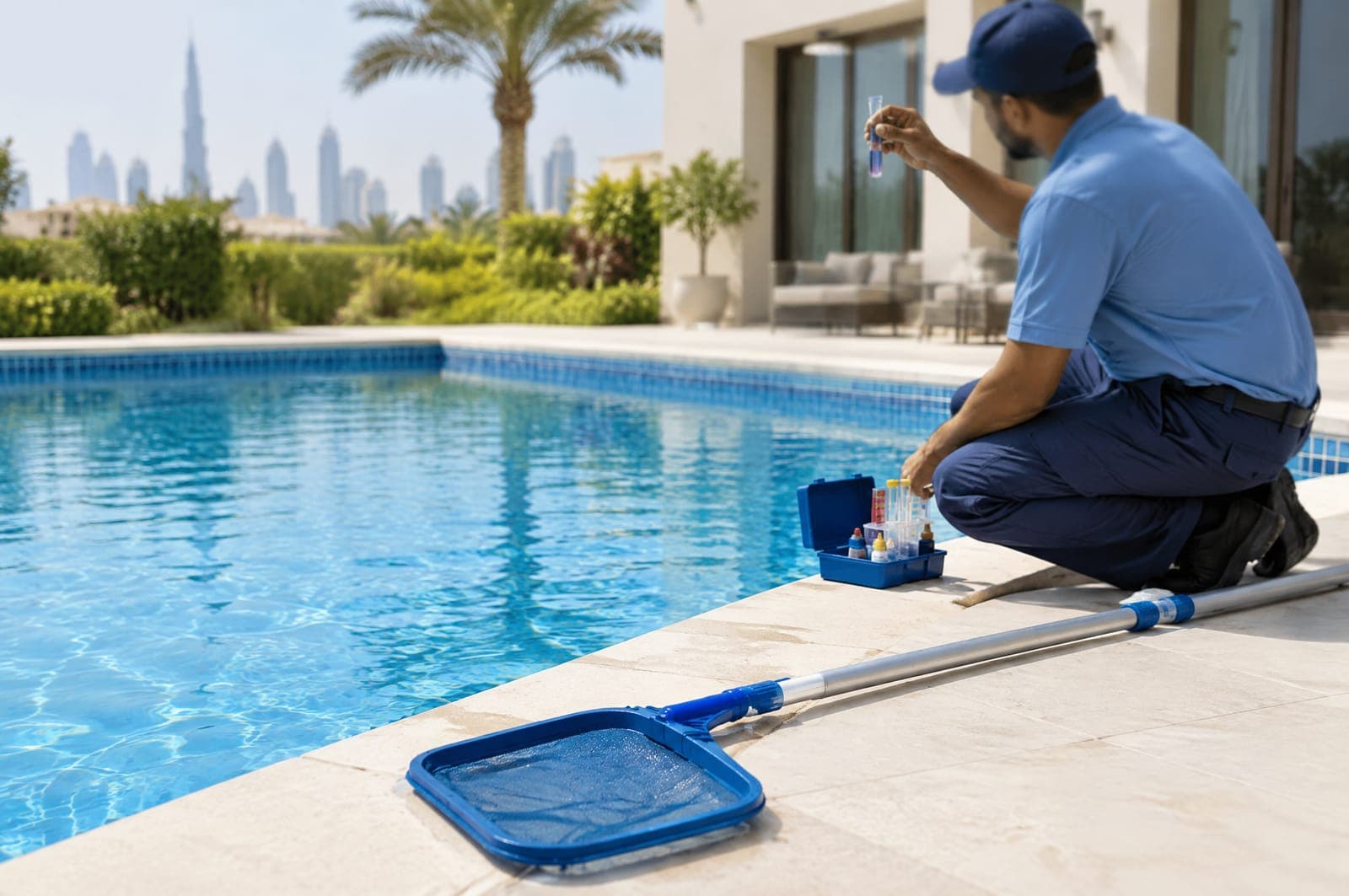
What should a pool maintenance contract include?
A good contract covers the routine work the authorities expect: regular cleaning, filter care, water testing and dosing, equipment checks and a written log. Repairs, parts, chemicals, laboratory tests and specialist work are the items to pin down, so get every inclusion and exclusion in writing and compare offers line by line.
Start with what the rules expect
Pool maintenance in the UAE is not only a matter of taste. Dubai Municipality's guideline for private villa pools says the owner or occupier must make sure a competent person carries out proper maintenance of the pool and its filtration and disinfection system. It also requires:
- regular cleaning of strainers, filters and pool walls
- immediate repair or replacement of damaged parts
- servicing of all equipment in line with the manufacturer's instructions, with pipes, filters and motors kept in good working order
- chemicals stored, handled and used according to the manufacturer's instructions and safety data sheets, in a lockable store
- daily testing of pH, chlorine and temperature before use, testing of calcium hardness, alkalinity, saturation index and cyanuric acid every 15 days, microbiological tests every two months, and all readings recorded in a logbook
For communal pools, pools in residential buildings and hotel pools, Dubai Municipality's public pool guideline puts the duty on the operator. The operator must make sure competent persons carry out regular, correct maintenance, that staff have the manufacturer's operation and maintenance manuals and work procedures, that permits to work are used for tasks such as electrical work or confined spaces, and that plant and equipment are inspected and tested as the manufacturer specifies.
In Abu Dhabi, the municipality's guide for public pools (it excludes private villa pools) requires the filter to be maintained and cleaned at least once a week, the bottom and walls cleaned daily, and water test readings recorded.
A maintenance contract is how most owners and operators meet these duties. Read any offer against them.
The gap most contracts leave open
Dubai Municipality asks for daily testing, and the CDC recommends testing chlorine and pH at least twice a day, more often when the pool is busy. A technician who visits once or twice a week cannot do that. Someone still has to: the owner, a member of staff or the contractor on a daily schedule. The contract should say who tests between visits, what kit they use and where the readings are recorded.
What the routine scope should cover
Ask for each of these to be written into the scope, with a frequency:
- Visits. How many per week, on which days, and roughly how long each visit lasts.
- Cleaning. Skimming, brushing walls and steps, vacuuming the floor, emptying skimmer and pump baskets.
- Filter care. Backwashing or cleaning according to the manufacturer. Pentair's cartridge filter manual, for example, says to clean the filter when the gauge reads 8 to 10 psi above the clean starting pressure.
- Water testing and dosing. Which parameters are tested at each visit, which every 15 days, and who arranges the two monthly microbiological test.
- Logbook. Readings, chemicals added and observations, signed and available to you.
- Equipment checks. Pump, filter, valves, dosing equipment, chiller or heat pump, lights and the auto fill, with faults reported in writing.
- Safety checks. Drain covers, enclosure gates and latches, rescue equipment and signage.
Exclusions to check
Offers that look similar on paper can differ on these items. Ask about each one directly.
- Chemicals. Included in the fee, charged at cost, or bought by you?
- Parts and repairs. Pump seals, gauges, valves and motors. Is labour for repairs included?
- Filter media. Pentair notes that cartridge life varies with bather load, wind and dust, with an average of about three years under normal conditions. Sand filters also need their media changed from time to time.
- Laboratory tests. Microbiological sampling every two months.
- Specialist work. Leak detection, chiller servicing, tiling, resurfacing.
- Electrical work. Lights, control panels and wiring must be handled by a qualified electrician. Find out whether the contractor employs one or subcontracts.
- Extra visits. Clean ups after a dust storm, call outs for faults and visits outside the schedule.
- Draining and refilling. Usually a separate job.
How to compare offers
Put the offers side by side against the same scope. Then compare:
- Competence. Dubai Municipality defines a competent person by education, ability, training and experience. Ask who will actually do the work and what training they have.
- Response times for faults and for water quality problems.
- Reporting. A written visit report with readings and photos is easier to check than a ticked box.
- Records. Who keeps the logbook, and can you see it at any time?
- Notice and handover. How the contract ends, and what records you receive when it does.
For buildings and hotels, add the operator's own obligations: risk assessments for maintenance work, permits to work and access control for plant rooms. A contractor who already works this way will make compliance easier.
A sensible position
The cheapest offer is rarely the one that covers the most. Choose the contractor whose scope matches your pool and your obligations, who records what they do, and who tells you early when something needs a specialist.
Questions people ask
How often should a pool technician visit?
There is no single figure in the guidelines, but Dubai Municipality expects daily testing and regular cleaning, and Abu Dhabi's public pool guide asks for weekly filter cleaning and daily cleaning of the floor and walls. Agree a visit frequency that matches your pool's use, and make sure daily testing is covered between visits.
Should chemicals be included in the contract price?
Either arrangement can work. What matters is that the contract says which chemicals are included, that each dose is recorded in the logbook, and that chemicals are stored in a locked area as the guidelines require.
Does a maintenance contract cover leak detection?
Usually it should be treated as separate specialist work. Ask the contractor to report signs of water loss, and agree in advance how a leak investigation would be arranged and paid for.
Sources
- Private Swimming Pools Safety Guidelines (DM-HSD-GU80-PRSPS2), Dubai Municipality, Health and Safety Department. Accessed 25 Oct 2026.
- Public Swimming Pools Safety Guidelines (DM-HSD-GU81-PSPS2), version 3.0, Dubai Municipality, Health and Safety Department. Accessed 25 Oct 2026.
- Guide to the Executive Regulations of Law No. (2) for the year 2012 (Swimming pools), Abu Dhabi City Municipality, Department of Municipalities and Transport. Accessed 25 Oct 2026.
- Guidelines for Keeping Your Pool Safe and Healthy, U.S. Centers for Disease Control and Prevention, Healthy Swimming. Accessed 25 Oct 2026.
- Clean & Clear Plus Cartridge Filters Owner's Manual, Pentair (manual hosted by Inyo Pools). Accessed 25 Oct 2026.
This guide explains general principles. It is not engineering advice and cannot tell you what is wrong with a specific pool. Rules change: check with the authority named in the sources before relying on them.