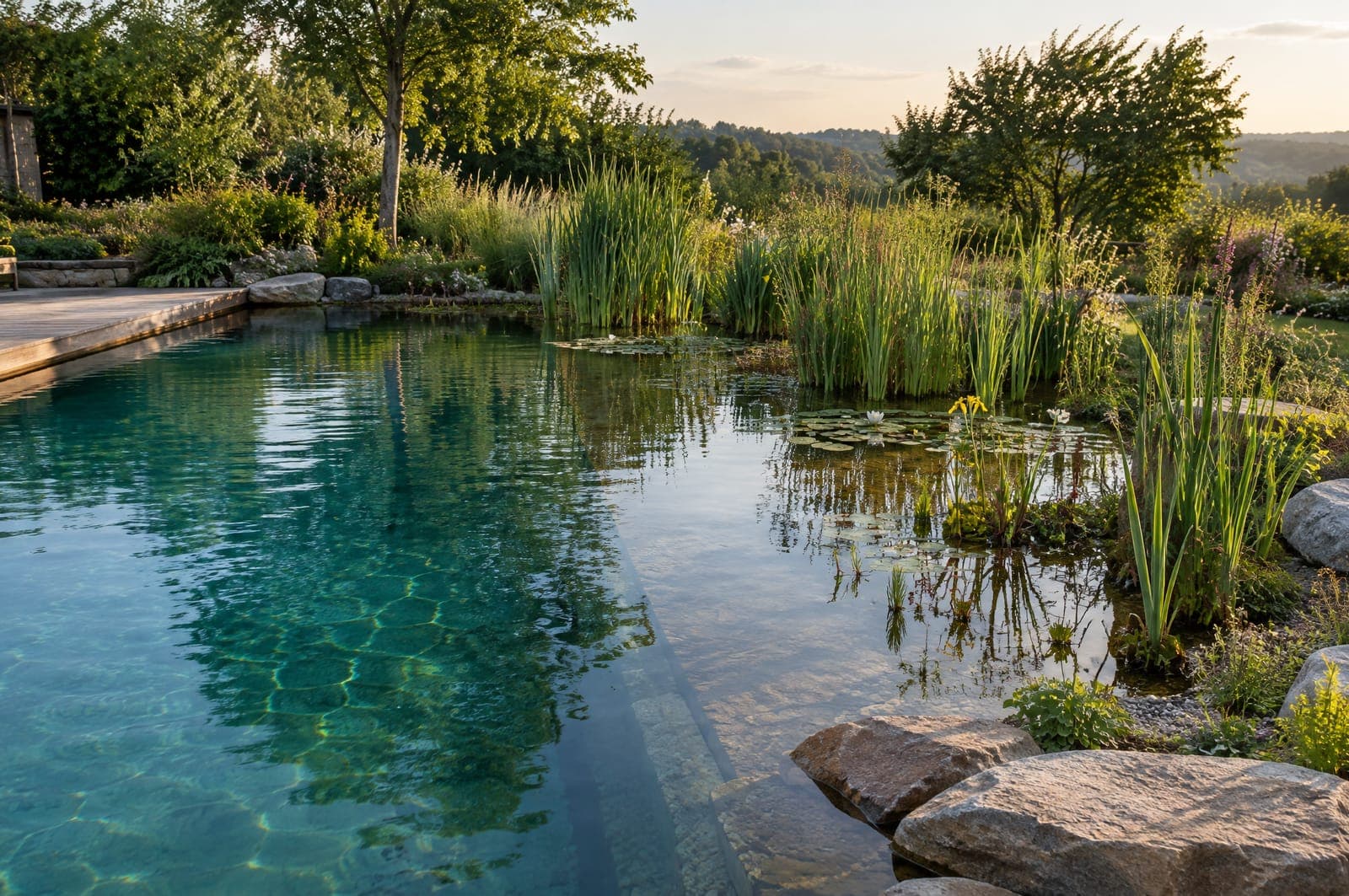
Natural pool
A natural pool cleans its water biologically instead of with chlorine. Water circulates between a swimming zone and a planted regeneration zone, or through a biological filter, where plants and micro-organisms remove nutrients. These pools need specialists who understand both the construction and the biology.
How it is built
Biotop, an Austrian natural pool company, describes the typical layout. The swimming zone and the regeneration zone are generally planned at a ratio of 1 to 1, with the swimming area at least two metres deep. Using more technology allows a smaller, shallower regeneration area. The two zones can be separated with special wall units. Biotop also states that a natural pool works in balance from a water surface area of 30 to 40 square metres, with no upper limit, which affects whether a smaller garden can take one.
In Biotop's design, a submersible pump sits in a chamber below the deck and is fed by gravity. A self-cleaning curved sieve skimmer with a 0.3 mm mesh removes floating particles, and a biological compact filter cleans the water without chemicals. Underwater plants absorb impurities as nutrients, and zooplankton such as water fleas are added to help keep the water clean. The company says the regeneration area must be designed correctly and the plants used properly.
Biotop describes two circuits: one cleans the surface and runs all day, the other removes organic compounds and runs continually during the swimming season.
Typical problems with age
Problems can include:
- Algae growth when nutrients build up or the balance between the zones is disturbed.
- Pump, skimmer or filter faults that reduce circulation.
- Plants dying back or overgrowing in the regeneration zone.
- Leaks in the waterproof lining, at the walls between zones or at pipe connections.
- Sediment collecting in the swimming zone.
Biotop notes that a new pool needs patience until it finds its natural balance, so some changes in the early period are expected.
What repairs usually involve
Mechanical faults are handled much like any pool: pump, skimmer and filter repairs. The biological side is different. Biotop states that absolutely no chemicals are required, so ask a natural pool specialist before adding any treatment.
Repairs to the lining, the zone walls or the planting are best carried out by a specialist in natural pools, ideally the original designer or installer, who knows how the system was meant to work. Ask for a written care plan that sets out what the owner, the gardener and the specialist each look after.
UAE notes
Biotop's planning guidance does not address hot climates. Water temperature, evaporation and plant selection are all questions to raise with a designer before building or renovating a natural pool in the UAE. Ask for examples of their pools that operate in similar conditions, and how the planting and filtration are adapted to them.
What to tell a specialist about your pool
- Designer or system, if known.
- Size of the swimming and regeneration zones.
- Type of filtration: planted zone, biological filter or both.
- What has changed: water clarity, algae, plants, water level or equipment noise.
- Any treatments or products added recently.
- Photos of both zones and the plant chamber.
Questions people ask
Can a regular pool company service a natural pool?
They can often help with pumps and pipework, but the biological side needs experience. Look for a specialist in natural or biologically filtered pools.
Can I add chlorine to clear green water?
Ask a specialist first. Biotop states that no chemicals are required in its natural pools, and the designer or installer should advise on any treatment.
How large does the regeneration zone need to be?
Biotop generally plans the swimming and regeneration zones at a ratio of 1 to 1, and says more technology allows a smaller regeneration area. The right size depends on the design.
Sources
- Planning your Natural Pool: As Much Nature as Possible, Biotop. Accessed 25 Oct 2026.
General information, not engineering advice. Only an inspection tells you what is wrong with a specific pool.
Specialists who work on this pool type
Infinite Leisure Pools
Abu Hail, Dubai
Unclaimed listingLeak detection, Tile and mosaic repair, Waterproofing, Heater and heat pump service, Full renovation
- Unclaimed listing
Equipment upgrades, Full renovation, Routine maintenance, New pool construction